3 Counting beyond 9
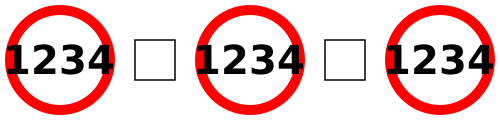
There is nothing to stop us counting beyond \(9\). Chances are you already know how to do it and won’t have any trouble answering the following questions. If you still cannot, just skip and come back to them after reading the rest of the chapter.
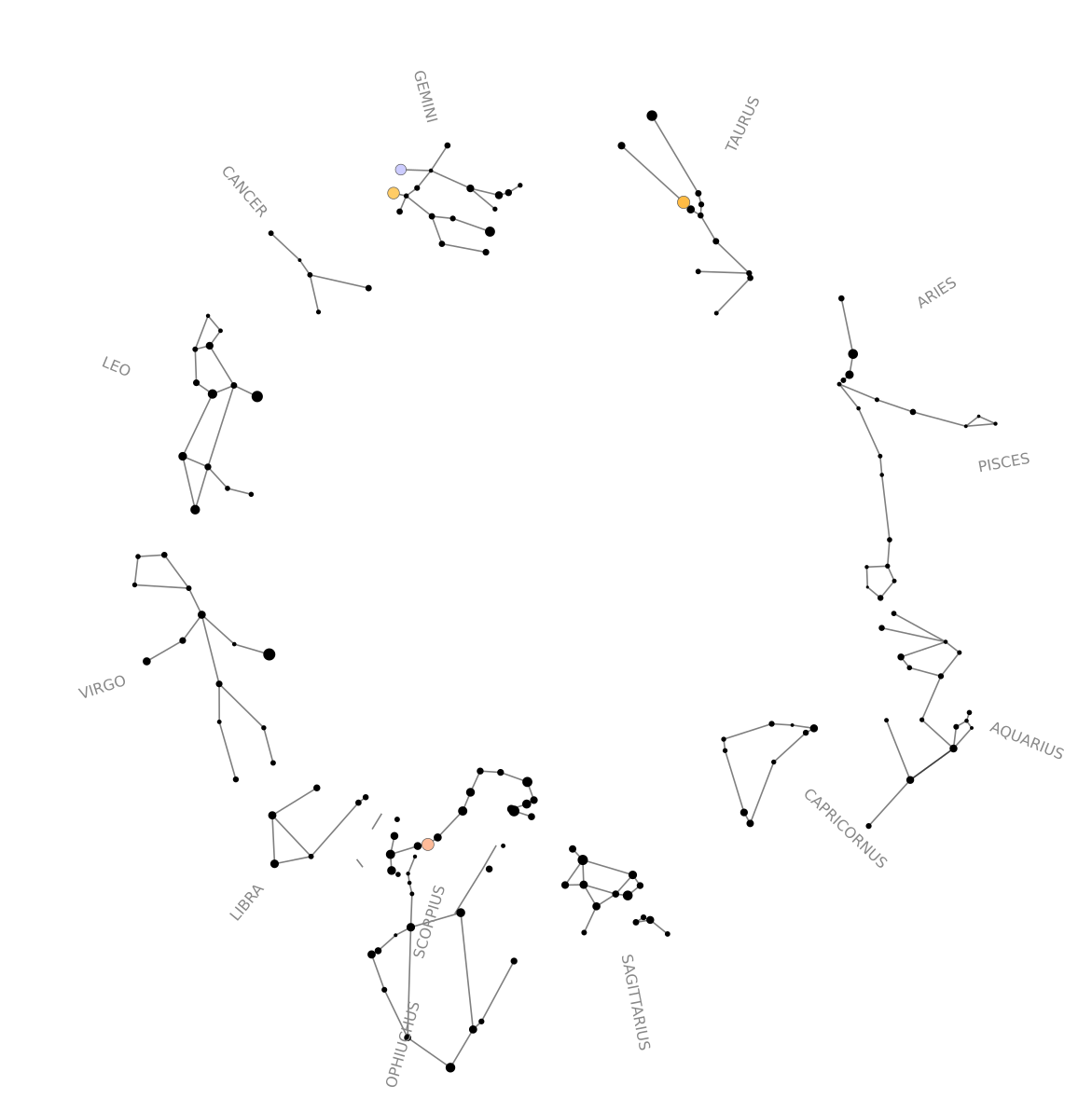
Find the total number of bikes.
However, the problem may lie in the way numbers are represented. In this chapter, we will learn how to represent and construct numbers larger than 9 using the decimal system.
3.1 How could we represent numbers greater than 9?
If we only have ten digits or symbols:
The decimal numbers. Ten digits.
TipDecem digiti
The word “digit” comes from the Latin word “digitus,” meaning “finger.” The plural form is “digiti.”
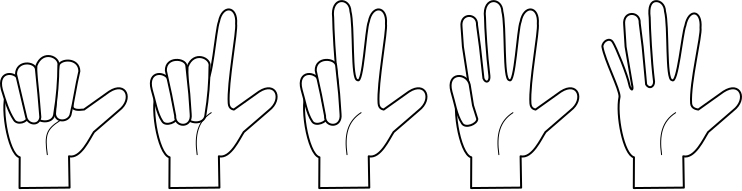
If we don’t want to introduce new symbols, it seems the only option is to reuse the same symbols in some way  . We need to exploit a different property or attribute of these digits somehow. Any ideas?
What about their color? We could establish a color convention where the value of the digitgs depends on their color.
Instead of color, we could use another attribute, such as size.
\(9\), , ,
If you quickly scan the page numbers in this book, you will see that this is not how it is done. Instead, we use the position of the digits.
Just as we can use the letters of the alphabet to write an infinite number of sentences and books, we can also use the ten decimal digits to represent infinite many numbers.
3.2 Positional number system
Numbers greater than \(9\) can be represented by combinations of the same ten digits in different positions. Any combination that starts with a number other than \(0\) is a valid number. Let’s see some examples:
\[ 10, \quad 123, \quad 9999999, \quad 100000000000, \quad \ldots \]
TipPositional number system in a nutshell
The defining feature of the positional number system is that the value of a digit depends on its position in the number. For instance, in the number \(333\), each digit \(3\) has a different value.
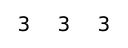
The farther to the left \(\Leftarrow\) a digit is, the larger its value. We will use boxes to emphasize the positions.
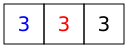
A digit’s value changes as soon as it is moved to a different position. For example, the resulting number changes each time the digit \(3\) is moved to the left; the larger the position to the left, the larger the number.
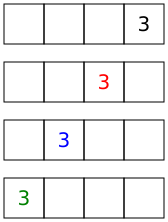
However, in the last example, these are not valid numbers. We need to fill the empty positions to the right.

You don’t need to know what the numbers are; you only need to know that the further to the left the digit \(3\) is, the larger the value it represents1:
\[ {\color{olive}{3}}000 > {\color{blue}{3}}00 > {\color{red}{3}}0 > 3 \]
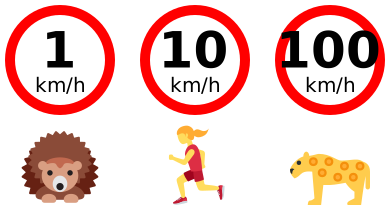
Even if you don’t know what the numbers mean, you can use what you just learned to determine which number is larger and who is faster in the figure below.
Explain why?
How to count and construct numbers beyond \(9\)?
We now how to count until \(9\):

To count beyond \(9\) we need two things: more positions and reusing the same digits.

Notice that after \(9\) we start reusing the same digits, beginning with \(0\), but now they are prefixed by the digit \(\color{red}{1}\).
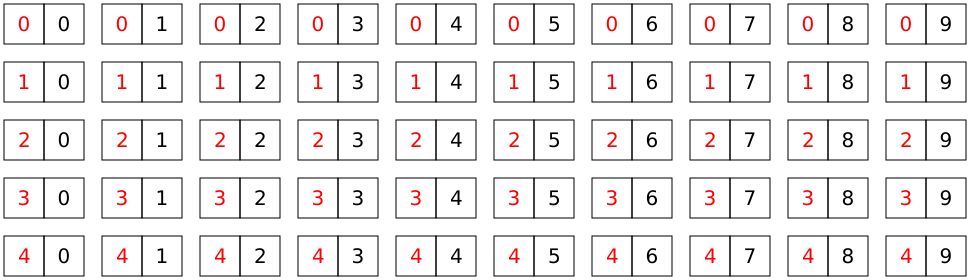
As you probably guessed, after \(19\) comes \(20\). Each time we reach a number ending in \(9\), we increase the leftmost digit by \(1\). If you only look at the \(\color{red}{\text{red}}\) digits, you will see that we are also counting in that position: \(\color{red}{0, 1, 2, 3, 4, \cdots}\). Here, we prefixed the first ten numbers with \(\color{red}{0}\) to emphasize that, but that doesn’t change the values.
If you answered \(99\), you are correct!

The answer is always the same: we need two things —more positions and reusing the same digits.

Notice that with the \(\color{blue}{\text{blue}}\) digits, we are also counting in the third position: \(\color{blue}{0, 1, 2, 3, 4, \cdots}\). Only, we count slower than we did with the \(\color{red}{\text{red}}\) digits. The most to the left we go, the slower we count.
This is a recurring process. We continue to do the same thing: add positions and reuse the same digits to create larger and larger numbers.
Exercises
- Write the numbers from \(0\) to \(31\).
- Write the numbers from \(90\) to \(110\).
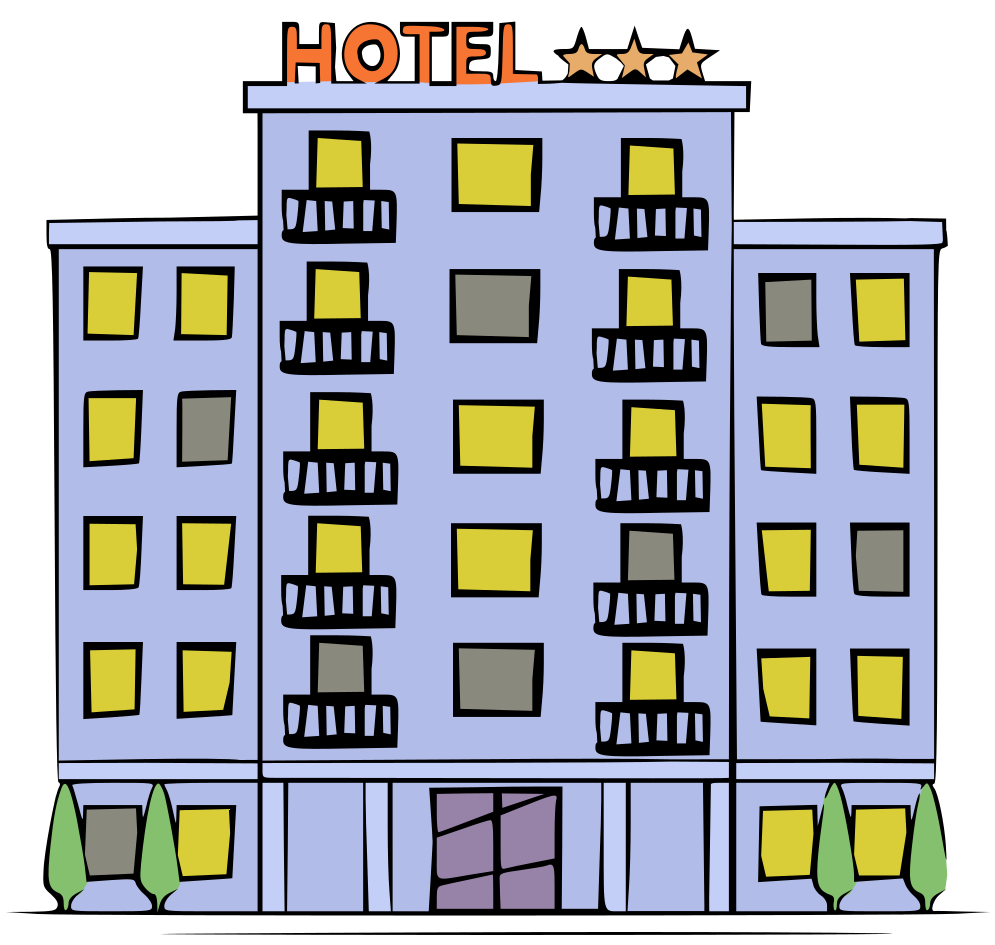
In order to master these insights and the way numbers are constructed, we are going on vacation! We’ll be staying at the Numbers Grand Hotel.
3.3 The Numbers Grand Hotel 
TipFun Fact
I am probably the first person to use the analogy of a Grand Hotel to explain mathematical concepts  .
.
Our Grand Hotel is a special one with ten rooms on each floor. The owner is a reasonable man, which is why the floor and room numbers start at zero.
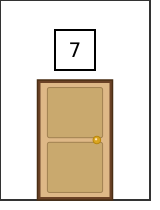
Our hotel rooms look like this. They have a door and a number on top of it.
The numbers on top of the door are very useful to identify the room. If our hotel has only one floor, we can easily identify a particular room with a single digit number.
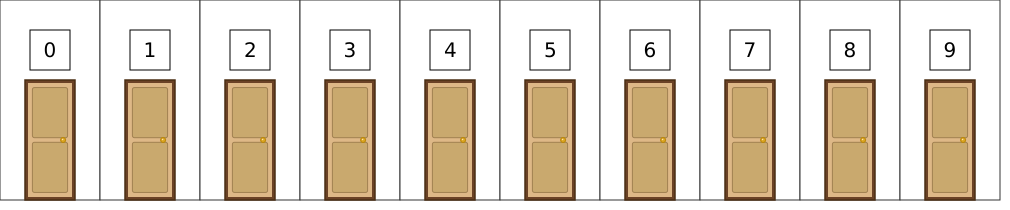
You wouldn’t have any problem finding room number \(7\) in the first floor, right? But what happen if our hotel has \(2\) or more floors?
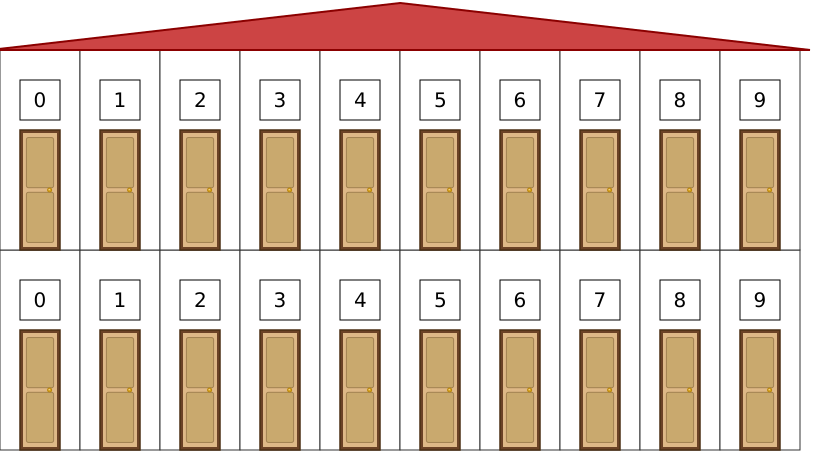
You cannot unambiguously identify Room \(7\) using single-digit numbers. Clearly, we need more numbers to represent additional rooms, and you already know how to construct larger numbers. As we saw in the previous section, the first thing we need to do to represent larger numbers is to add more positions.
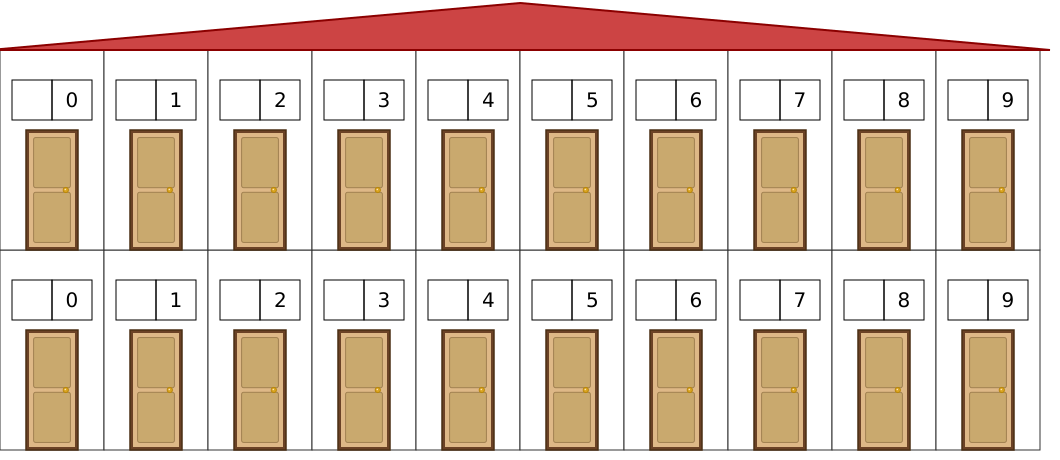
That’s right; you also need to specify the floor number. For example, you could say “Room \(7\) on the \(0\) floor” or “Room \(7\) on the \(1\) floor.”
We will now add a second digit to each door in the second placeholder to represent the floor number. The first position, the rightmost one, is for the room number; the second position is for the \(\color{red}{\text{floor number}}\).
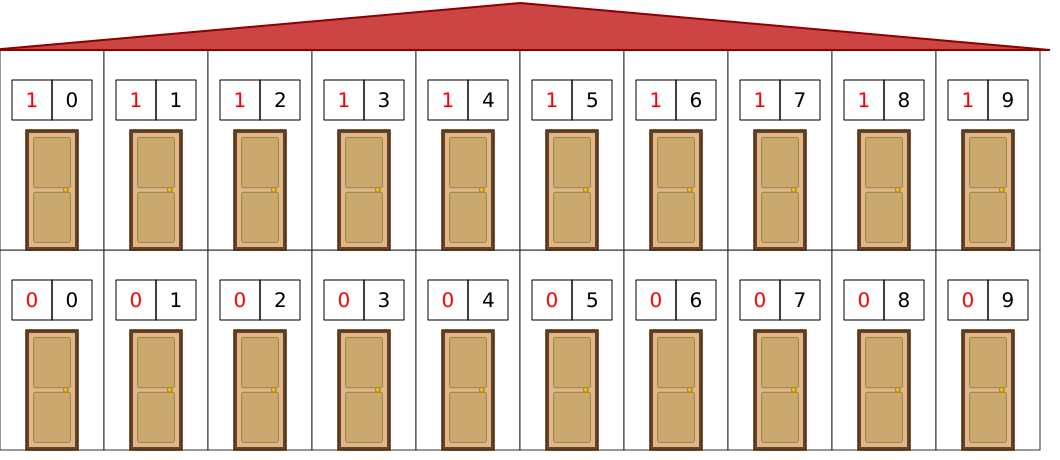
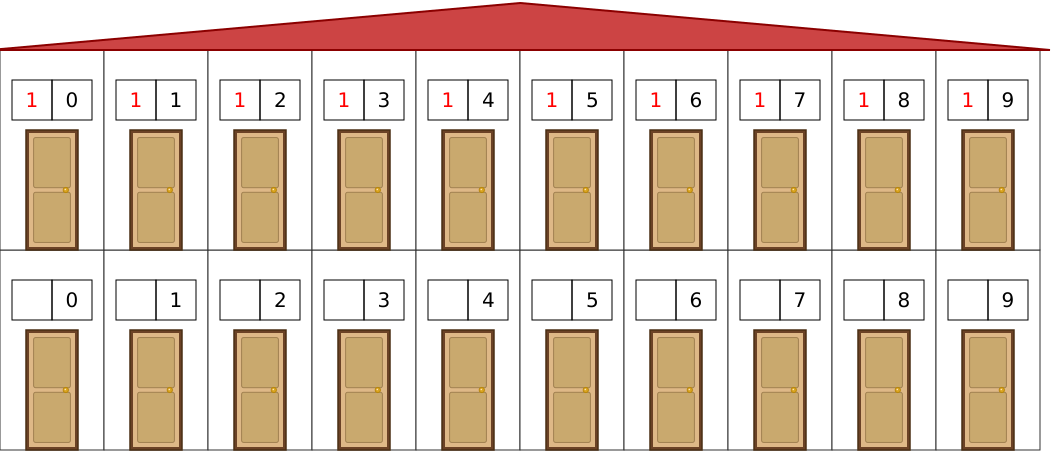
In the first floor, we don’t really need those padding zeros in front, so we can safely remove them. The following numbering is equivalent to the previous one.
To get from one room on the ground floor (floor \(0\)) to the corresponding room on the first floor (floor \(1\)), we have to climb a ladder.
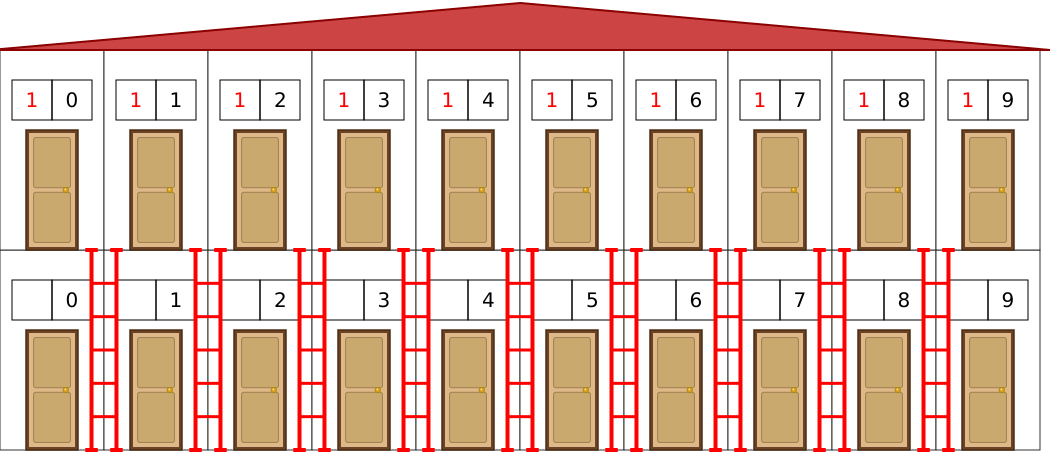
Climbing a ladder means adding \(10\). For example, climbing a ladder from Room \(7\) on the ground floor will take you to Room \(17\) on the first floor, which is \(17 = 7 + 10\).
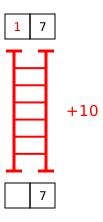
If we need to go further, we have to climb more ladders. Think of the second placeholder in each room (the red digit) as the floor number or the number of ladders climbed from the ground floor to get there.
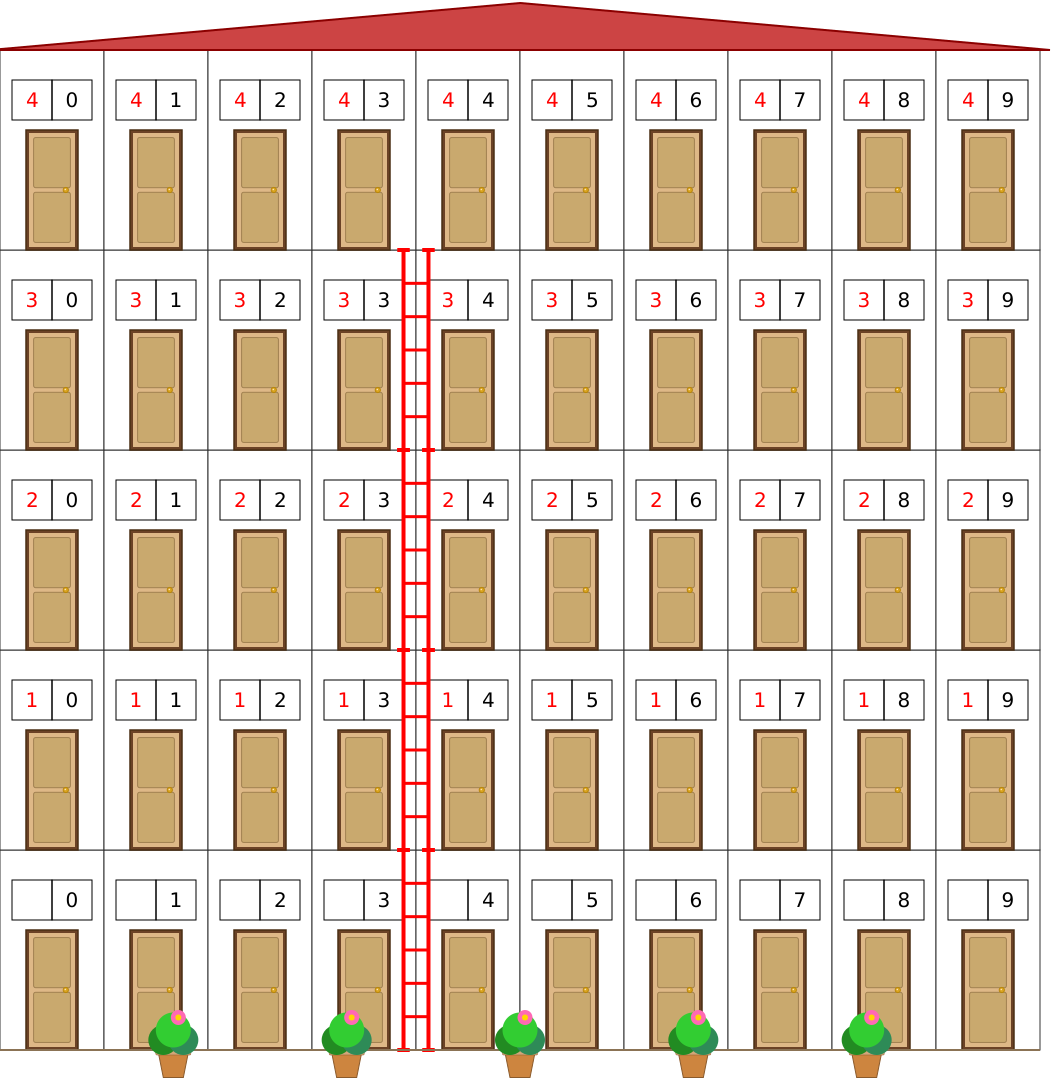
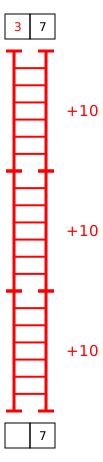
Ladders can be stacked. Every ladder represents the number of times we add \(10\).
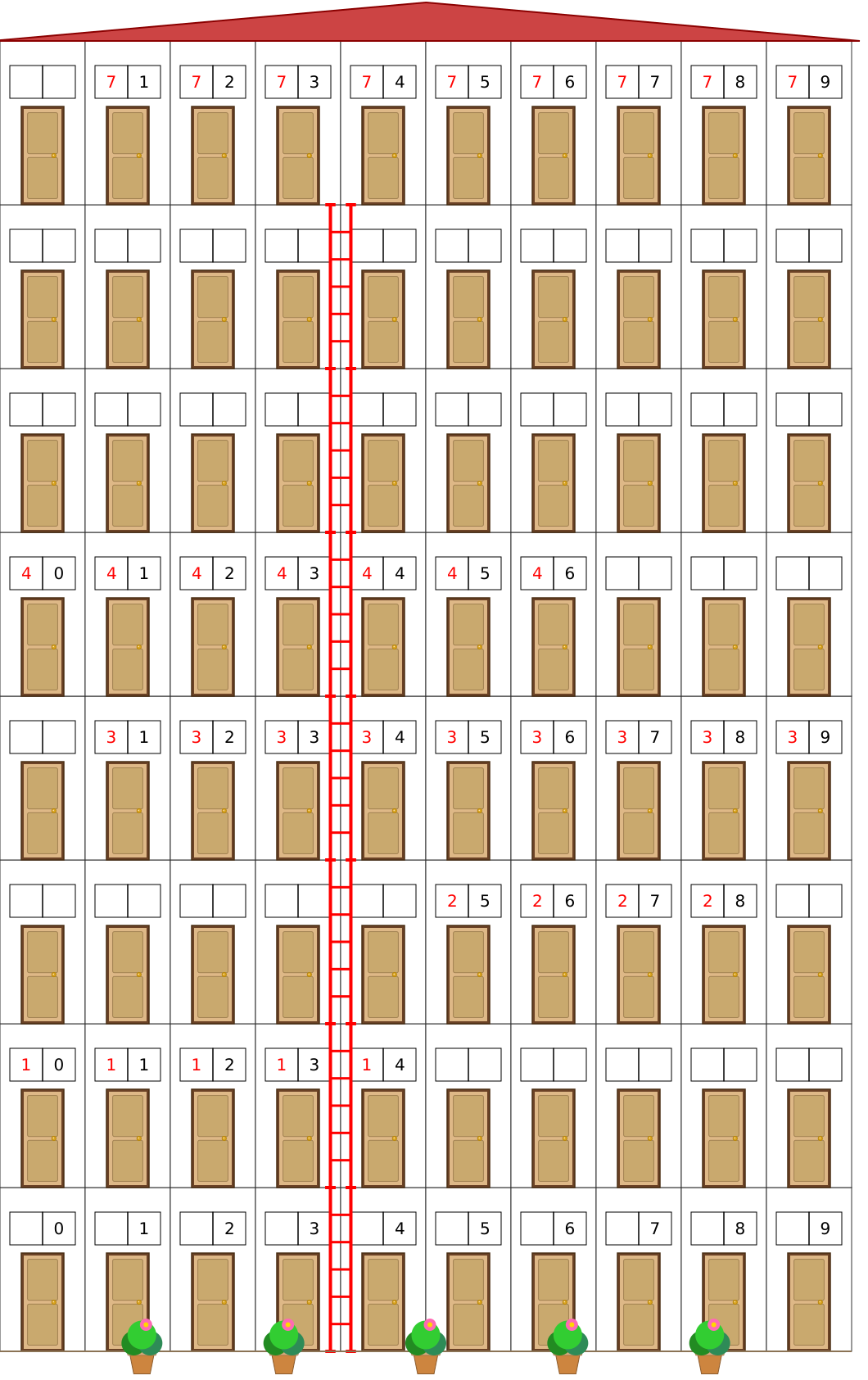
Exercises
Fill in the blanks with the numbers of the missing rooms.
You saw that adding \(10\) is quite easy, you just have to climb one ladder to the next floor.
\[ \begin{aligned} 0 + 10 &= 10\\ 1 + 10 &= 11\\ 2 + 10 &= \boxed{\phantom{13}}\\ 3 + 10 &= \boxed{\phantom{13}}\\ 4 + 10 &= \boxed{\phantom{13}}\\ 5 + 10 &= \boxed{\phantom{13}}\\ 6 + 10 &= \boxed{\phantom{13}}\\ 7 + 10 &= \boxed{\phantom{13}}\\ 8 + 10 &= \boxed{\phantom{13}}\\ 9 + 10 &= \boxed{\phantom{13}}\\ 1 + 20 &= 21\\ 7 + 20 &= \boxed{\phantom{13}}\\ 2 + 30 &= \boxed{\phantom{13}}\\ 2 + 40 &= \boxed{\phantom{13}}\\ \end{aligned} \]
3.4 Base 10
The base of the decimal system is \(10\).
The reason the number system we have used so far is called the “decimal number system” and each floor of our Grand Hotel has ten rooms is because we are using a number system based precisely on the number \(10\). Ten is the base of this system. What does that mean?
On the one hand, it means that we have ten digits or symbols:
The decimal numbers. Ten digits.
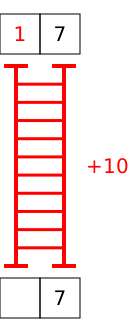
It also means that all numbers greater than \(9\) are constructed adding one of these ten digits to combinations of \(10\)2.
In our Grand Hotel analogy, climbing a floor means adding up \(10\). Each time we climb a ladder, we add \(10\). If we climb two ladders we add two times \(10\), \(2\times 10 = 10 + 10 = 20\), if we climb \(5\) ladders we add five times \(10\), \(5\times 10 = 10 + 10 + 10 + 10 + 10 = 50\), and so on.
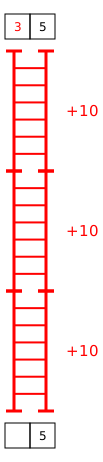
This is how some of the new numbers we just learned are constructed using the base \(10\):
\[\begin{align*} 13 &= 3 + (1\times 10) = 3 + (\underbrace{10}_{1\text{ time}}) &= 3 + 10 \\ 23 &= 3 + (2\times 10) = 3 + (\underbrace{10 + 10}_{2\text{ times}}) &= 3 + 20 \\ 24 &= 4 + (2\times 10) = 4 + (\underbrace{10 + 10}_{2\text{ times}}) &= 4 + 20 \\ 35 &= 5 + (3\times 10) = 5 + (\underbrace{10 + 10 + 10}_{3\text{ times}}) &= 5 + 30 \\ \end{align*}\]
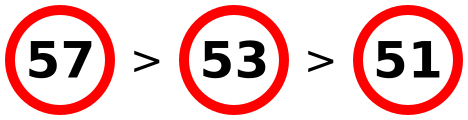
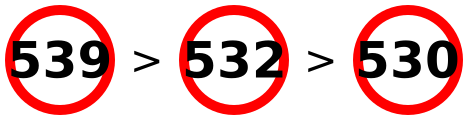
Here are a few rules  to compare quantities of any number of digits.
- If one number has more digits than the other, then it is larger.

- If two quantities have the same number of digits, we compare their most significant digits. The quantity with the greater most significant digit is greater.

- If two quantities have the same number of digits and their most significant digits are the same, then we compare their second most significant digits. We continue this process until we break the tie or reach the least significant digit.
Exercises
Compare the following quantities and write \(>\), \(<\), or \(=\) accordingly.