The decimal numerals
1 Counting
1.1 Introduction
God made the integers, all else is the work of man. Leopold Kroneker
In conveying messages within the human brain, counting is far more fundamental than language. Ronald Calinger, A Contextual History of Mathematics.
Counting is arguably the most fundamental operation in mathematics. This seemingly trivial process provides the foundation for many areas of mathematics and is central to numerous results, algorithms, and proofs. Counting is pervasive. You will encounter it in instances ranging from playing Snakes and Ladders to solving a Rubik’s Cube efficiently to proving the most elusive theorem in the history of mathematics.
TipDo aliens count?
Some people speculate that if we were to encounter extraterrestrial intelligence elsewhere in our universe, one thing we might have in common is the ability to count, albeit in different ways. For example, you would count differently if you had six fingers instead of ten, or no fingers at all.

1.2 Decimal numerals 
The numbers we use for counting —zero, one, two, three, \(\dots\)— are called counting or natural numbers and are represented with this nicely looking \({\color{red}{\mathbb{N}}}\).
\[ \color{red}{\mathbb{N} = \{0, 1, 2, 3, 4 \cdots\}} \]
The three dots, \(\cdots\), mean that the sequence continues forever, until the heavens of infinity. Whether or not to include zero in the set of natural numbers is a matter of convention—or rather, a matter of contention.
Numbers are abstract entities, so defining them is difficult. I’m not going to do that here, but you could try asking your parents or teachers what numbers are. Ask them something like, “What is the number five?” and observe their reaction  .
.
NoteParent/Educator Tip
What is number 5? What is a number? To delve deeper into this and other intricate philosophical questions, I recommend reading a book on the philosophy of mathematics1. This doesn’t necessarily mean that you will find a satisfying answer, or any answer at all.
We represent numbers with symbols called “numerals.” There are different types of numerals; we will look at some of them later.
Most of the time, we will use Hindu-Arabic numerals. These are the symbols we see everywhere and are most familiar with. We see them on our house doors, watches, phones, football jerseys, birthday candles, and the page numbers of this book.
TipNumbers and stars
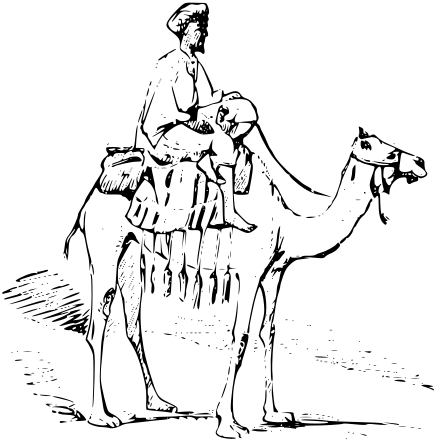
These symbols are called Hindu-Arabic numerals. Arab scholars adopted them from India. Along with the names of the stars and many other scientific and mathematical discoveries, they are among the beautiful things that the Arab tradition has bridged from other cultures or created for us.
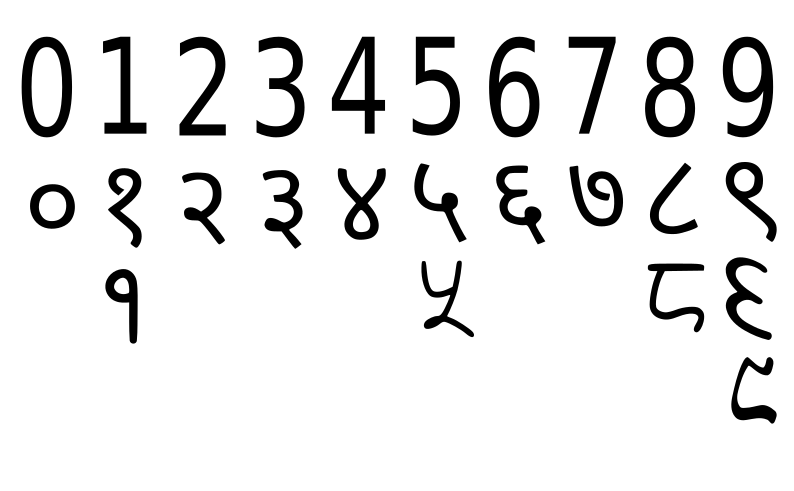
Hindustani numerals. Source image: Wikipedia.

Go ahead and practice your strokes while enjoying the roundness of the numbers.
1.3 Counting objects 
We use natural numbers to represent the quantity of objects or entities. Natural numbers are used for counting and answering questions that imply “How many?”
- How many siblings do you have?
- How many legs do dogs have?
- How many horns did a triceratops have? What about unicorns?
- How many candles were in your last birthday cake?
Sometimes the answer is a very special quantity: zero, \(0\). Consider the answer to the question “how many horns do you have?” Hopefully none.
TipA number to represent nothingness
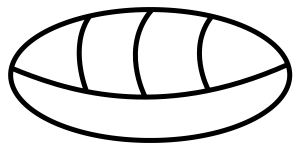
The invention of zero (\(0\)), a number representing nothingness, was a significant milestone in the history of mathematics. Not all cultures recognized the concept of zero immediately or had a value for representing nothingness. The one in the picture is the Mayan zero. Doesn’t it look like a rugby ball? Source image: Wikipedia.

Let’s see how to use decimal numerals to represent quantities. For example, how many elephants do you see in the next figure? You would agree that the answer is three.
Let’s practice our counting skills!
Important Bedtime stories drawn in the sky
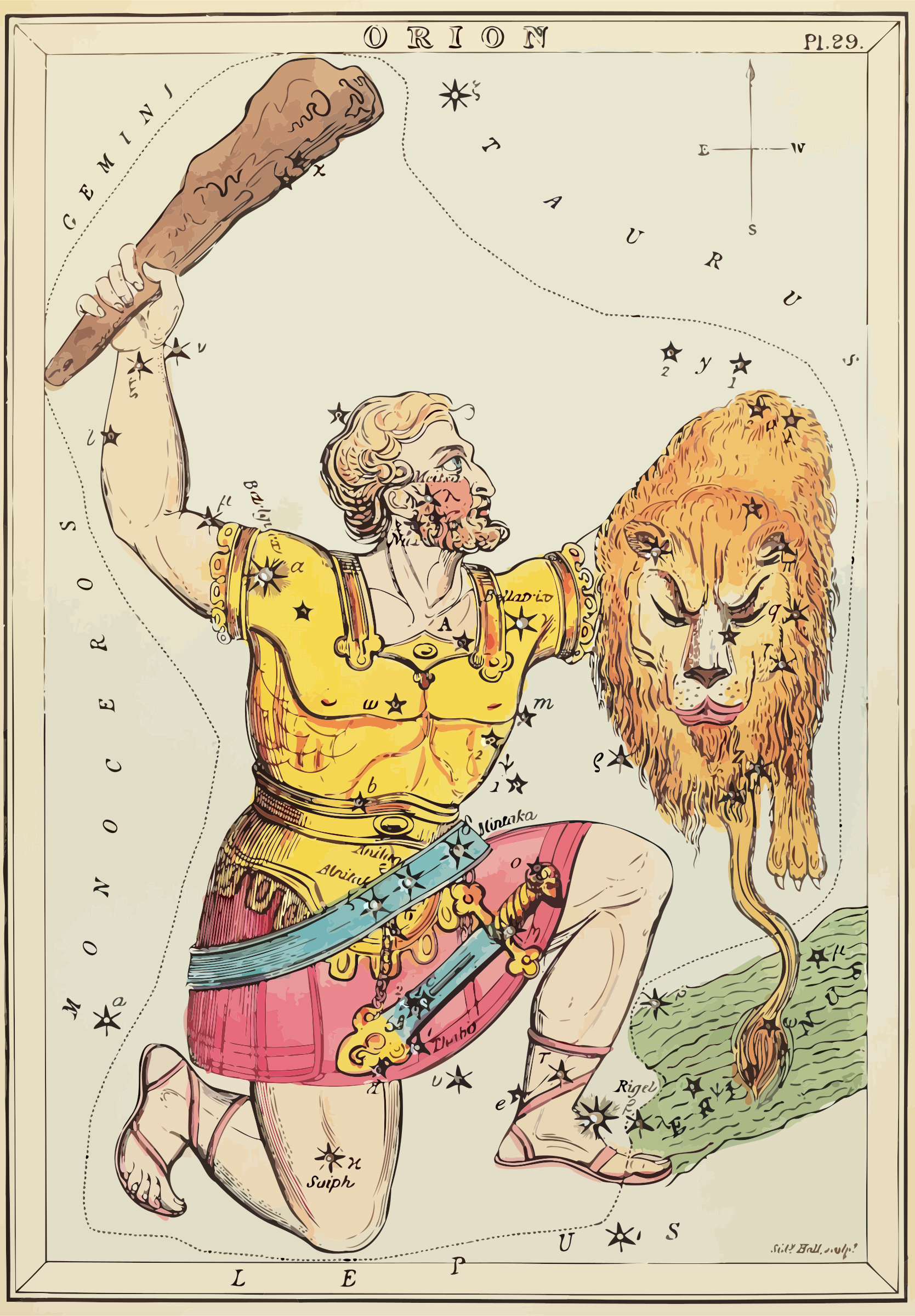
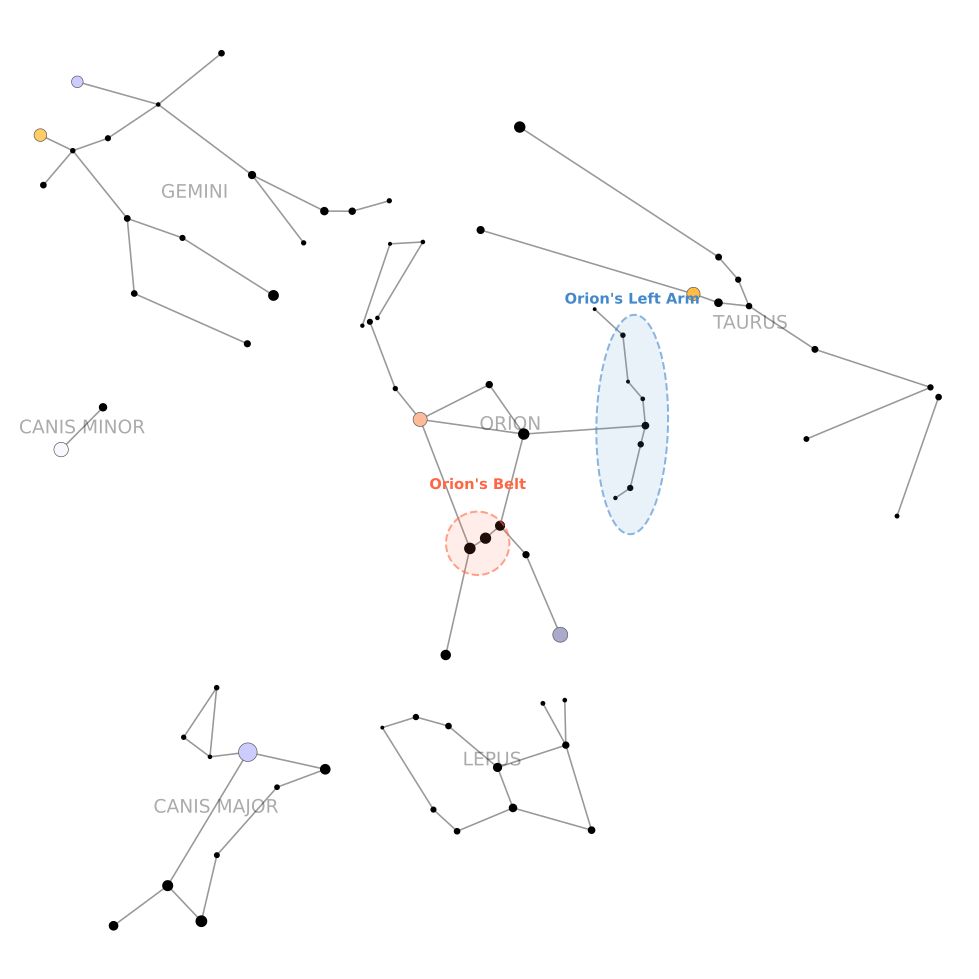
Orion, the son of Poseidon and Euryale, was an unrivaled hunter. Even Artemis, the goddess of the hunt, enjoyed hunting with him. However, her brother Apollo grew jealous of Orion and sent a giant scorpion to sting him. After Orion died, Artemis forgave Apollo, and they immortalized him in the sky as the eponymous constellation. He is followed by his two faithful dogs, represented by the constellations Canis Major  and Canis Minor . The dogs are pursuing the poor hare, represented by the constellation Lepus
  . Scorpius, a summer constellation, is usually not seen with Orion at the same time.
You can find more about this story in D'Aulaires Book of Greek Myths. Doubleday, 1962, and Penguin Random House 1992.
This hunting scene is depicted in the night sky (just look up), as shown in figure Figure 1.1. The neighboring constellations Taurus  , the bull, and Gemini
  , the twins, are also shown in the figure.
Answer the following questions based on figure Figure 1.1:
- How many stars are in the Orion Belt? Do you know their names?
- How many stars can you see in the Greater Dog (Canis Major)? How many do you see in the smaller one, Canis Minor? I know the Lesser Dog doesn’t really look like a dog.
- How many stars are there in Orion’s lion skin on his left arm? Sometimes, instead of a lion skin, it is depicted as a shield, but the number of stars remains the same.
- How many orange-red stars do you see in this picture? In which constellations? Do you know their names?
NoteParent/Educator Tip
If this example sparked your interest in astronomy and the night sky, here are a series of recommendations:
- Stellarium2: A free, open-source planetarium software.
- Constellations (Princeton University Press, 2012) by Govert Schilling: A beautifully illustrated book about constellations, their history and mythology.
- Canis Major3: A project combining the two. It provides animations, including constellations, groups of constellations, orbits, etc.
1.4 Addition and substraction 
Imagine that you are building a tower out of LEGO bricks. Each time you add a brick to the top, the total number of bricks in the tower increases, meaning the tower gets taller. If you start with one brick and add a second, the tower is now one brick taller. Now, you have \(2\) bricks.


Similarly, if you start with \(2\) blocks and add \(3\), your tower’s height increases by \(3\), it is now \(5\) blocks tall.


Adding up means increasing a quantity by another quantity, or combining two quantities to obtain a new, larger, quantity. There is small nuance to this definition that we will review once we have introduced negative numbers.
We use the \(\color{red}{\text{plus}}\) symbol \(\color{red}{+}\) to represent addition, and the symbol \(\color{blue}{\text{=}}\), or \(\color{blue}{\text{equals}}\), to represent the result.
Using this notation we can represent the previous statements more compactly as:
- \(1 {\color{red}{\text{ plus }}} 1 {\color{blue}{\text{ equals }}} 2 \to\) \(1{\color{red}{+}}1{\color{blue}{=}}2\), and
- \(3 {\color{red}{\text{ plus }}} 2 {\color{blue}{\text{ equals }}} 5 \to\) \(3{\color{red}{+}}2{\color{blue}{=}}5\).
1 LEGO block plus 1 LEGO block equals 2 LEGO blocks.
2 LEGO blocks plus 3 LEGO blocks equals 5 LEGO blocks.
When you’re done playing or you want to build something more exciting than a tower, or when your mom asks you to clean up, you start removing blocks out of the tower and putting them in the LEGO box. This decreases the number of blocks in the tower, making the tower shorter and shorter.
Substraction means removing things. We use the minus sign, \(\color{red}{-}\) to represent this. For instance, if your LEGO tower has \(5\) blocks and you remove \(3\), you are left now with \(5 {\color{red}{\text{ minus }}} 3\), which \({\color{blue}{\text{ equals }}} 2\). Using the new notation we just learned: \(5 {\color{red}{-}} 3 {\color{blue}{=}} 2\).
5 LEGO blocks minus 3 LEGO blocks equals 2 LEGO blocks.
Exercises
Of course, you can add and substract with other things than LEGO blocks.
Addition means combining quantities. So far, we have combined two quantities, but we can combine more.
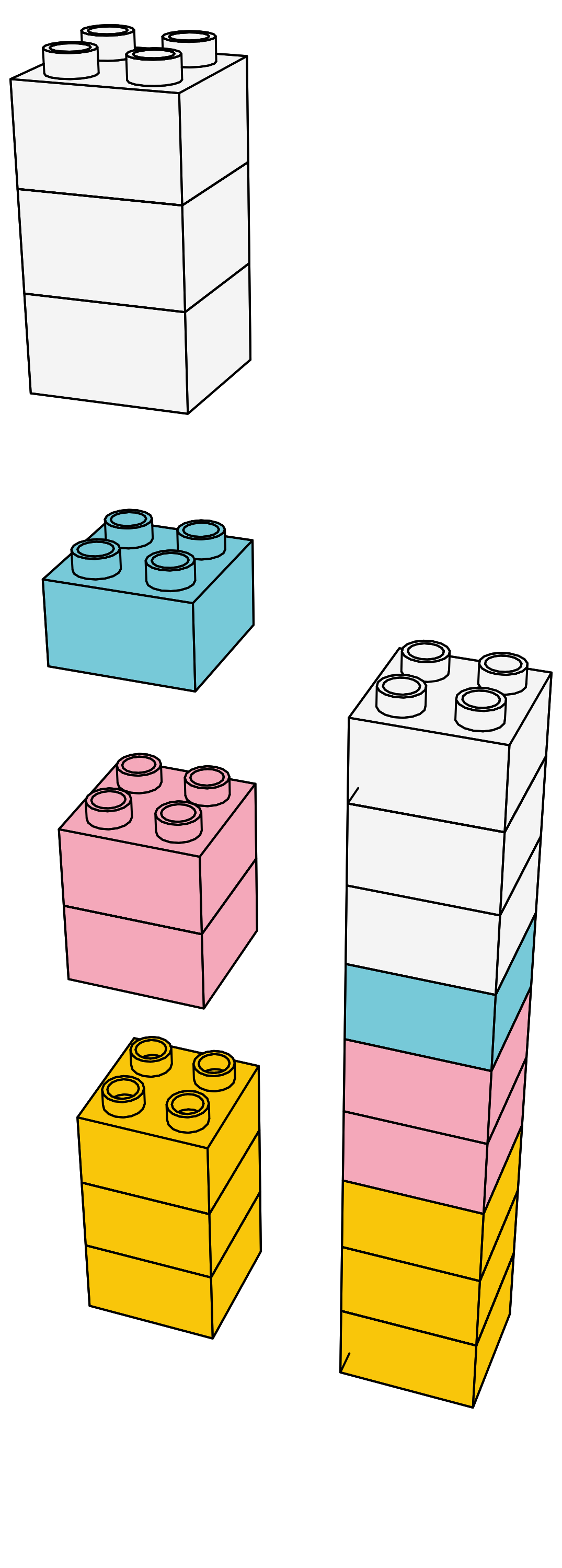
For example, in the following figure, we are adding \(3\) white bricks, \(1\) blue brick, \(2\) pink bricks, and \(3\) yellow ones. This represents the sum \(3 + 1 + 2 + 3\), which equals \(9\).
When adding more than two numbers, it is helpful to break the process down into smaller steps. We can group the summands in different ways. The cool thing is that the result will always be the same, no matter how we group them. This property of addition is called associativity. For example, in the following figure, we are grouping the bricks in different ways, but we always end up with \(9\) bricks.
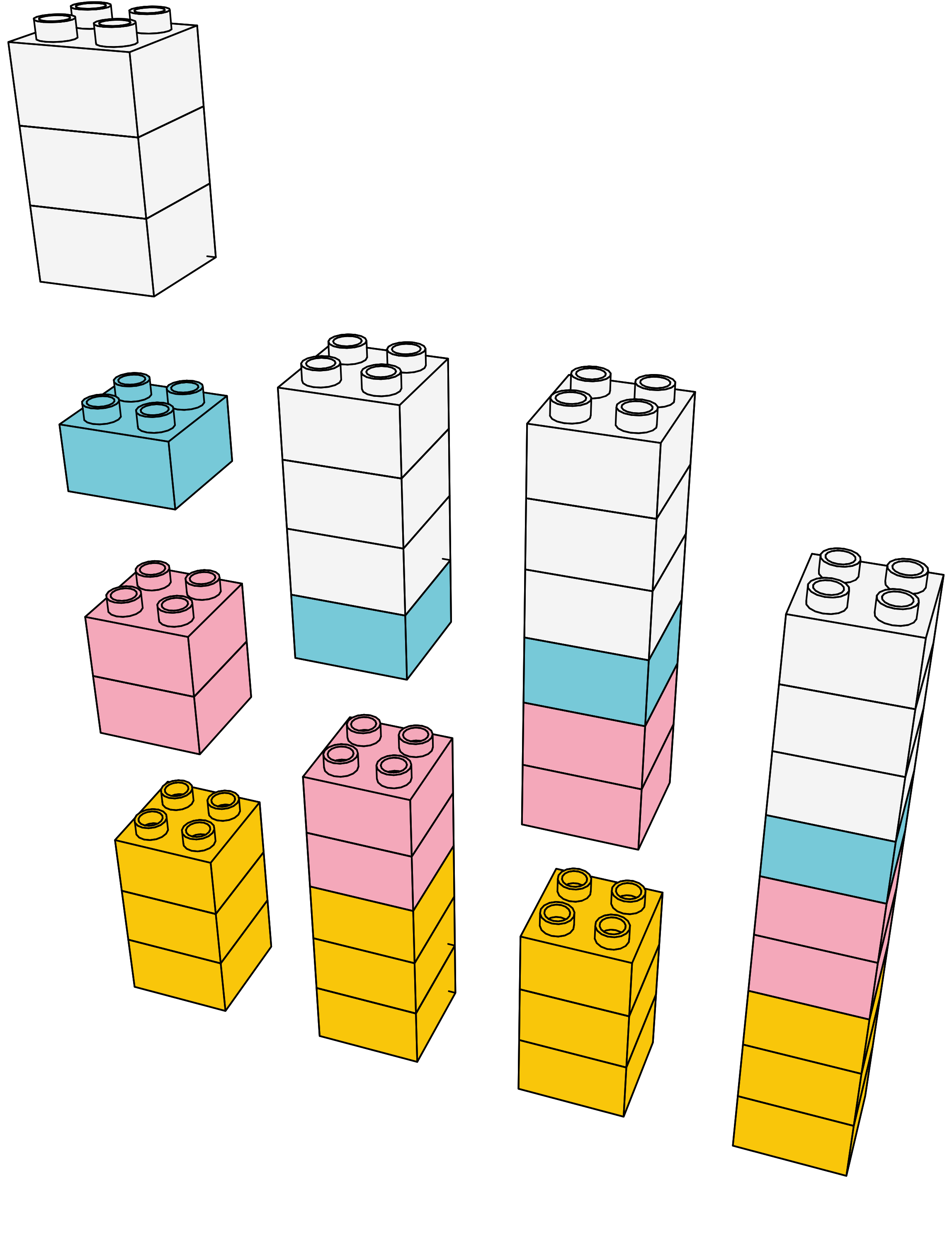
We can use parentheses to indicate which numbers we should group together and add up first.
\[ \underbrace{\underbrace{(\underbrace{(3+1)}_{3+1={\color{red}{4}}}+2)}_{{\color{red}{4}}+2={\color{blue}{6}}}+3}_{{\color{blue}{6}}+3={\color{green}{9}}} = 9 \]
However, we can also associate numbers differently:
\[ \underbrace{\left(\underbrace{(3 + 1)}_{3 + 1 = {{\color{red}{4}}}} + \underbrace{(2 + 3)}_{2 + 3 = {{\color{blue}{5}}}}\right)}_{{\color{red}{4}} + {\color{blue}{5}} = {{\color{green}{9}}}} = 9 \]
Now that you have that knowledge, let’s solve the following sums. You can use beads, your fingers, or LEGO bricks to help with the calculations.
\[\begin{align*} 3 + 2 &= \boxed{5} \\ 1 + 1 &= \boxed{2} \\ 2 + 3 + 1 &= \boxed{\phantom{3}} \\ 1 + 0 &= \boxed{\phantom{5}}\\ 0 + 1 + 2 + 3 &= \boxed{\phantom{5}}\\ 9 - 0 &= \boxed{\phantom{5}}\\ 9 - 1 &= \boxed{\phantom{5}}\\ 9 - 2 &= \boxed{\phantom{5}}\\ 9 - 3 &= \boxed{\phantom{5}}\\ 7 - 4 &= \boxed{\phantom{5}}\\ 0 + 0 &= \boxed{\phantom{5}}\\ 3 - 3 &= \boxed{\phantom{5}}\\ 3 + 5 &= \boxed{\phantom{5}}\\ 5 + 3 &= \boxed{\phantom{5}}\\ 5+ 3 -3 &= \boxed{\phantom{5}}\\ 5+ 2 -3 &= \boxed{\phantom{5}}\\ \end{align*}\]
Caution The order doesn't matter
Sometimes, the order of things matters. For example, it matters whether you put on first your shoes  or your socks
  .
.
Other times, order doesn’t matter, such as when adding up numbers. For instance, did you notice that \(3 + 2\) yields the same result as \(2+3\)?



In the general case we have
\[ a + b = b + a \]
\(a\) and \(b\) represent any two numbers. We say that addition is commutative, meaning the order of the numbers being added does not matter.
Provided you enter the right answers in the previous examples, we say that the equality holds. Try now yourself to create some equalities that hold, both with additions (‘\(+\)’) and substractions (‘\(-\)’).
NoteParent/Educator Tip
Encourage the kids to do this on their own, you can provide a few examples.
\[\begin{align*} \boxed{\phantom{5}} \quad \boxed{\phantom{5}} \quad \boxed{\phantom{5}} &= \boxed{\phantom{5}} \\ \boxed{\phantom{5}} \quad \boxed{\phantom{5}} \quad \boxed{\phantom{5}} &= \boxed{\phantom{5}} \\ \boxed{\phantom{5}} \quad \boxed{\phantom{5}} \quad \boxed{\phantom{5}} &= \boxed{\phantom{5}} \\ \boxed{\phantom{5}} \quad \boxed{\phantom{5}} \quad \boxed{\phantom{5}} &= \boxed{\phantom{5}} \\ \boxed{\phantom{5}} \quad \boxed{\phantom{5}} \quad \boxed{\phantom{5}} &= \boxed{\phantom{5}} \\ \boxed{\phantom{5}} \quad \boxed{\phantom{5}} \quad \boxed{\phantom{5}} &= \boxed{\phantom{5}} \\ \boxed{\phantom{5}} \quad \boxed{\phantom{5}} \quad \boxed{\phantom{5}} &= \boxed{\phantom{5}} \\ \boxed{\phantom{5}} \quad \boxed{\phantom{5}} \quad \boxed{\phantom{5}} &= \boxed{\phantom{5}} \\ \boxed{\phantom{5}} \quad \boxed{\phantom{5}} \quad \boxed{\phantom{5}} &= \boxed{\phantom{5}} \\ \boxed{\phantom{5}} \quad \boxed{\phantom{5}} \quad \boxed{\phantom{5}} &= \boxed{\phantom{5}} \\ \end{align*}\]
1.5 Playing hide-and-seek with numbers 
TipPlaying hide-and-seek
Did you know that with the operations you just learned, you can actually play hide-and-seek? The game consist in finding numbers that are hiding? It is like finding the missing piece of a puzzle.
In elementary algebra we call those hiding numbers “unknowns” or “variables”.

To find the value of the hidden number in the following equation, ask yourself: What number plus \(2\) equals \(7\)?
\[ \text{\style{font-size:1em}{🧩}} + 2 = 7 \]
The answer:
\[ \text{\style{font-size:1em}{🧩}} = 5 \]
Because
\[ 5 + 2 = 7 \]
Exercises
In the following equations, find the uknown. The hidden numbers are hidding inside a box like this one \(\boxed{\phantom{5}}\), go and find them!
\[\begin{align*} \boxed{\phantom{5}} + 3 &= 8\\ \boxed{\phantom{5}} + 7 &= 8\\ 7 + \boxed{\phantom{5}} &= 8\\ 2 - \boxed{\phantom{5}} &= 0\\ 2 - \boxed{\phantom{5}} &= 1\\ \boxed{\phantom{5}} + 3&= 8\\ 7 + \boxed{\phantom{5}} &= 7\\ 7 - \boxed{\phantom{5}} &= 7\\ 9 + \boxed{\phantom{5}} &= 9\\ 9 - \boxed{\phantom{5}} &= 9\\ 1 + \boxed{\phantom{5}} &= 2\\ 2 - \boxed{\phantom{5}} &= 1\\ \end{align*}\]
TipFun Fact
In algebra those unknown variables are usually represented by letters, like \(\color{red}{x}\) or \(\color{red}{\alpha}\).
So, instead of \(3 + \boxed{\phantom{4}} = 7\), you will see \(3 + {\color{red}{\alpha}} = 7\). We will learn later on powerful methods for finding not one but multiple of those sneaky numbers, provided they exist!

In many instances in science and engineering you are not given these equations, but instead some observations or a problem. Nature speaks mathematics, but still you will have to convert observations into equations.
- Example 1: If I tell you that Zoe is \(2\) years older than you, and then I ask you what’s Zoe’s age? How would you go about and solve this problem? In this kind of problems you always have two categories, what you know: the data, observations, given information, and what you don’t know, the sneaky unknowns. In this case you know your own age, let’s say \(5\), and you know that Zoe is \(2\) years older. The resulting equation would be:
\[ \begin{aligned} 5 + 2 &= \boxed{\phantom{5}} \ \end{aligned} \]
- Example 2: the temperature tomorrow is going to be \(3\) degrees colder than today. It is going to fall to \(6\) degrees. What is the temperature today? In this case the data is the temperature tomorrow, \(6\) degrees, and the relationship between today and tomorrow, that is the temperature tomorrow is \(3\) degrees colder than today. The unknown is the temperature today. The resulting equation would be:
\[ \begin{aligned} \boxed{\phantom{5}} - 3 &= 6 \ \end{aligned} \]
- In the Zoo there are 2 lions
 , 2 elephants
  , \(1\) giraffe
  and an unkown number of orangutans
  ?. If the total number of animals in the zoo is \(9\), how many orangutans are there?
\[\begin{align*} \boxed{\phantom{5}} \quad + \quad \boxed{\phantom{5}} \quad + \quad \boxed{\phantom{5}} &= \boxed{\phantom{5}} \\ \boxed{\phantom{5}} \quad - \quad \boxed{\phantom{5}} &= \boxed{\phantom{5}} \end{align*}\]
- If I remove all the red blocks from a tower that is \(7\) blocks tall, I am left with \(2\) blocks. How many red blocks were there in the tower?
\[ \begin{aligned} \boxed{\phantom{5}} \quad \boxed{\phantom{5}} \quad \boxed{\phantom{5}} &= \boxed{\phantom{5}} \end{aligned} \]
- The distance between two cities is \(7\) kilometers. If I have already traveled \(4\) kilometers, how many kilometers do I have left to travel?
\[ \begin{aligned} \boxed{\phantom{5}} \quad \boxed{\phantom{5}} \quad \boxed{\phantom{5}} &= \boxed{\phantom{5}} \end{aligned} \]
1.6 A preview of multiplication
A special case of addition (or substraction) is when you add a number to itself. For instance \(3+3\), what we can read as three plus three, but also two times three. There is nothing stopping us at two times, so we can also continue to \(3+3+3\), which is read three times three, or \(3+3+3+3\) or four times three.
This operation, repeated addition, is called multiplication and is represented by the times symbol \(\times\).
We can then write \(3+3+3+3\) in a more compact way as \({\color{red}{4}}\times 3\) that is read \(\color{red}{4}\) times \(3\).
\[ \begin{aligned} \underbrace{3+3+3+3}_{{\color{red}{4}} \text{ times}} &= {\color{red}{4}} \times 3 \\ \end{aligned} \]
Here is another example: \(1\) apple + \(1\) apple + \(1\) apple is the same as \(3\) times \(1\) apple, which is \(3\) apples.
\[ \begin{aligned} \underbrace{\text{\style{font-size:1em}{🍎}}\ + \text{\style{font-size:1em}{🍎}}\ + \text{\style{font-size:1em}{🍎}}}_{{\color{red}{3}} \text{ times}} &= {\color{red}{3}} \times \text{\style{font-size:1em}{🍎}} &= {\color{red}{3}} \text{\style{font-size:1em}{🍎}}\\ \end{aligned} \]
More generally, if a number \(a\) is added to itself \(n\) times
\[ \begin{aligned} \underbrace{a + a + \cdots + a}_{{\color{red}{n}} \text{ times}} &= {\color{red}{n}} \times a \end{aligned} \]
We will revisit multiplication later on. For the time being, you can already do multiplications, albeit in a slower way, using one of your superpowers: addition.
Exercises
Do the following multiplications by doing adding up repeatedly.
\[\begin{align*} 1 \times 2 &= 2 &= \boxed{2} \\ 2 \times 2 &= 2 + 2 &= \boxed{4} \\ 3 \times 2 &= 2 + 2 + 2&= \boxed{\phantom{5}} \\ 4 \times 2 &= 2 + 2 + 2 + 2&= \boxed{\phantom{5}} \\ 2 \times 3 &= 3 + 3 &= \boxed{\phantom{5}} \\ 3 \times 3 &= 3 + 3 + 3 &= \boxed{\phantom{5}} \\ 2 \times 4 &= 4 + 4 &= \boxed{\phantom{5}} \\ \end{align*}\]
1.7 Comparing quantities
- What would you prefer, two ice-creams or one ice-cream?
- Are your siblings older or younger than you?
- What about your best friends, are they older than you?
- What do you prefer \(2\), \(1\) or \(0\) portions of onion soup?
NoteParent/Educator Tip
Encourage the kids to reason about their answers. Ask many “Why’s?”
Think for a second how you answered those questions. What you did, even if unconsciuously, was a comparison between two or more quantities.
We already saw a kind of relationship between two quantities, namely when they are equal, now we are going to see the two other options.
| Name | Symbol | Example | Description |
|---|---|---|---|
| Equal | \(=\) | \(3 = 3\) | \(3\) is equal to \(3\) |
| Greater-than | \(>\) | \(3 > 1\) | \(3\) is greater than \(1\) |
| Less-than | \(<\) | \(0 < 1\) | \(0\) is less than \(1\) |
For instance I am sure you would prefer \(2\)  bars of chocolate instead of \(1\) because \(2 > 1\) and \(0\) portions of cauliflower soup instead of \(1\) because \(1 > 0\).
TipFun Fact
In a way, the greater-than symbol \(>\) is the same as the less-than one \(<\). What you have to remember is that the open part always points to the larger quantity, and the angle to the smaller one.
For instance, if you see something like \(7 > 2\) you can read it as \(7\) is greater than \(2\), but also as \(2\) is less than \(7\), and write it as \(2 < 7\). Same thing!
Time to practice.
Exercises
Write down the correct symbol (\(>\) or \(<\)) in the box.
\[\begin{align*} 3 \quad \boxed{>} \quad 0\\ 3 \quad \boxed{<} \quad 4\\ 3 \quad \boxed{\phantom{>}} \quad 1\\ 3 \quad \boxed{\phantom{>}} \quad 3\\ 9 \quad \boxed{\phantom{>}} \quad 8\\ 7 \quad \boxed{\phantom{>}} \quad 7\\ 7 \quad \boxed{\phantom{>}} \quad 8\\ 7 \quad \boxed{\phantom{>}} \quad 9\\ 1 \quad \boxed{\phantom{>}} \quad 0\\ \end{align*}\]
TipOptimization
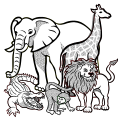
Which animal is the tallest? Which one is the heaviest? These kind of questions implies also comparisons of quantities, in this case heights and weights which are numbers. Given some quantities like \(2,4,7,2,8,9,2\), we can define:
Minimum: the smallest number. The number that is less-than (\(<\)) all other numbers in the collection. A number \(x^{*}\) such that \(x^{*} \leq y\) for all \(y\) in the collection. There might multiple instances of this number. In this example, the minimum value is \(2\).
Maximum: the largest number. The number that is greater-than (\(>\)) all other numbers in the collection. A number \(x^{*}\) such that \(x^{*} \geq y\) for all \(y\) in the collection. There might be also multiple instances of this number. In this example, the maximum is \(9\).
These points (minima and maxima) are called extrema (plural of extremum) and they are very important in many branches of mathematics, physics, engineering and economics.
Imagine you are going to have a birthday party and the following kids are attending.
| Name | Age | Name | Age |
|---|---|---|---|
| Jonas | 5 | Miguel | 4 |
| Lea | 7 | Zoe | 4 |
| Matilde | 2 | Amelie | 6 |
| Lucas | 2 | Zelia | 9 |
Answer the following questions:
- Who is older, Jonas or Lea?
- Who is the oldest between Miguel, Zoe and Amelie?
- Who is the youngest kid in the party?
- Who is the oldest kid in the party?
Based on the following figures, write down the corresponding relation and answer the following questions:
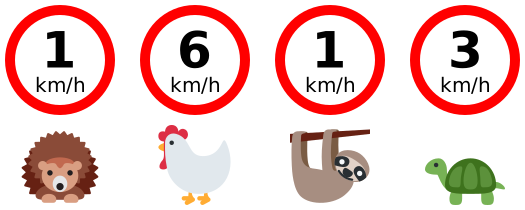
- Who is faster, the rooster or the turtle?
\[ \begin{aligned} \boxed{6} \quad > \quad \boxed{3}\\ \end{aligned} \]
Answer: The rooster  is faster.
- Who is faster, the hedgehog or the rooster?
\[ \begin{aligned} \boxed{\phantom{1}} \quad \boxed{\phantom{1}} \quad \boxed{\phantom{1}}\\ \end{aligned} \]
- Who is slower, the sloth or the turtle?
\[ \begin{aligned} \boxed{\phantom{1}} \quad \boxed{\phantom{1}} \quad \boxed{\phantom{1}}\\ \end{aligned} \]
- Which animal is the slowest?
\[ \begin{aligned} \boxed{\phantom{1}} \quad < \quad \boxed{\phantom{1}} \quad < \quad \boxed{\phantom{1}} \quad < \quad \boxed{\phantom{1}} \\ \end{aligned} \]
Time to play
Warning Game Theory
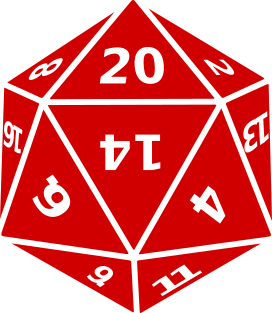
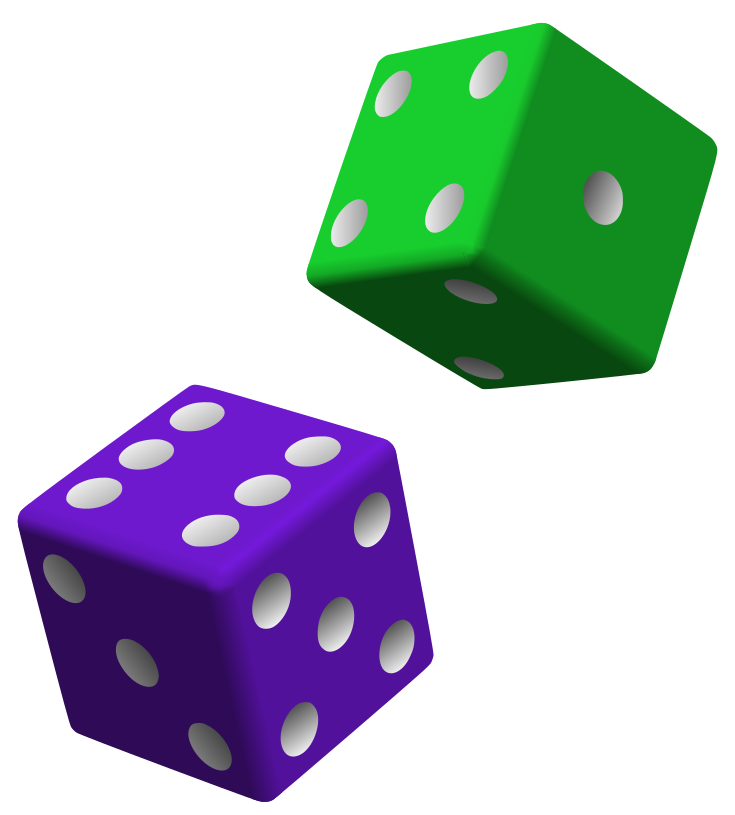
Now that you can compare quantities, you can start playing. One the simplest and oldest games is the dice game. In some languages the word for die is “bone”, because people used to play with certain animal bones. Take turns and roll a die, the player with the highest number wins. If you play with multiple dice, the player with the highest sum wins.
As we will see soon in Section 1.9, dice are usually built as regular polyhedral solids. The most common one is a cube or hexahedron (with 6 faces). But there are also dice with 4, 8, 10, 12 and 20 faces.
Warning Game Theory
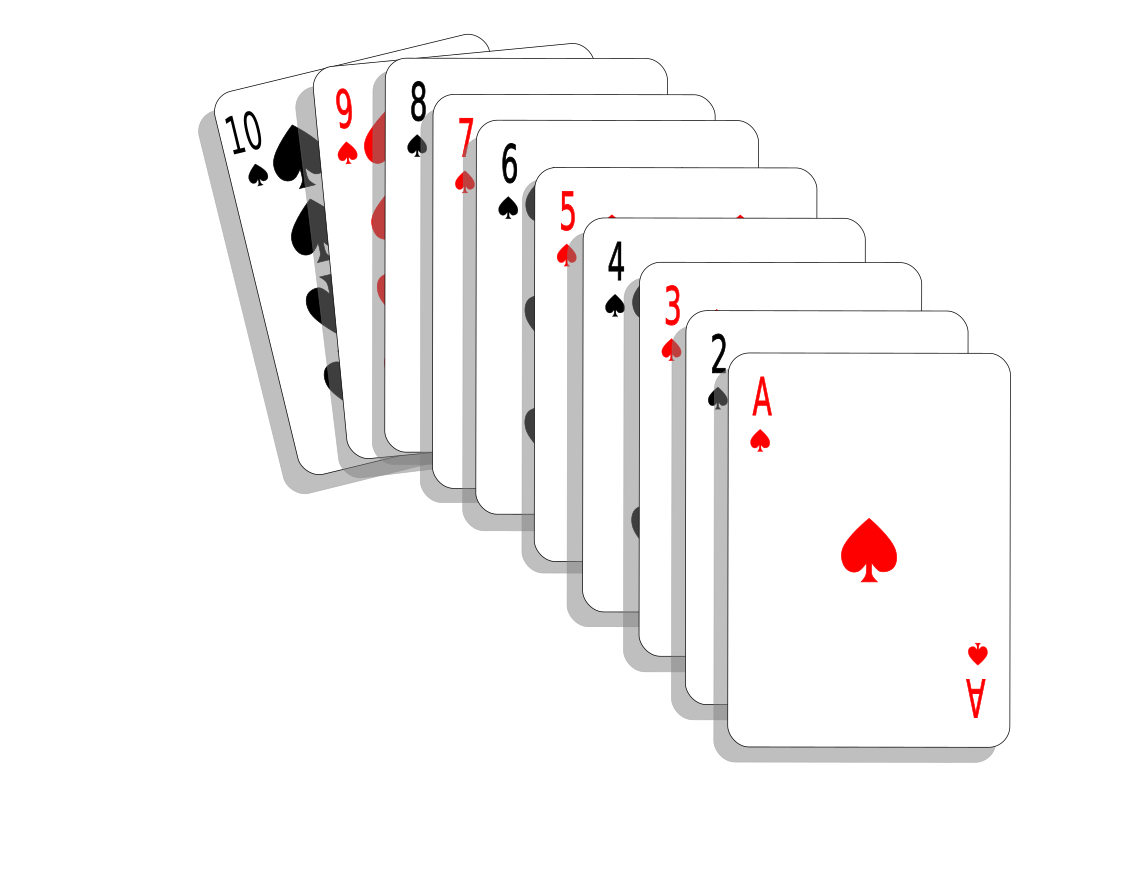
Card games are another instance where comparing is fundamental. In many games, the objecive is to sort the cards in increasing or decreasing order.
For instance, The Mind is a cooperative card game where players have to play cards in alternate turns, and the cards have to be played in increasing order. The catch is that the players are not allowed to talk to each other, so they have to rely on their intuition and on the timing of their plays to guess when to play their cards.
1.8 Introducing the Soroban abacus
My fellow townsman, Jaime García Serrano, has a superpower. He can perform complex mathematical computations in his head in the blink of an eye. That’s why people call him “the human calculator.”
He claims that he is not a genius, but rather that he developed a method based on his early work with the Japanese abacus, as well as through a lot of practice.
Do you see? Like playing the cello, dancing, or climbing mountains, math is something you get better at by practicing.
NoteParent/Educator Tip
Having a real abacus can be practical and fun. Make sure you spend some time teaching the kids how to use it and which fingers to use. There are plenty of good online resources for that.
This is a Python library for drawing these Soroban abacuses: https://github.com/twaclaw/soroban.
A Soroban abacus looks like this:
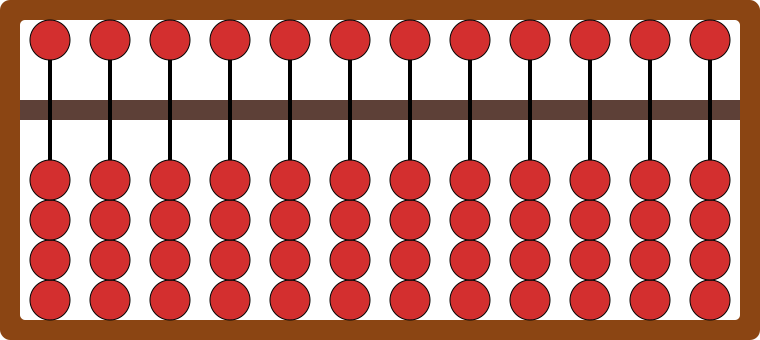
The number of columns can vary. For now, we will be using a tiny, cute one-column Soroban.

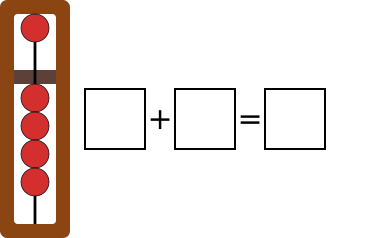
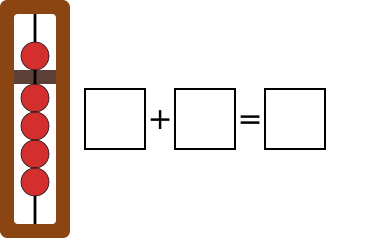
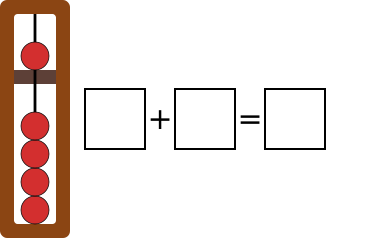
The beads on an abacus represent quantities, and you can perform operations like addition and subtraction with them. The dark bar inside the abacus is called the “answer” bar. Beads only add to the value if they touch the answer bar.
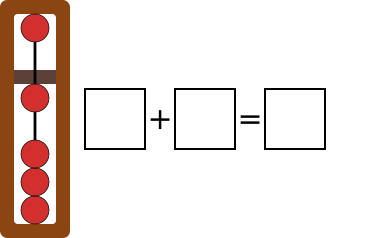
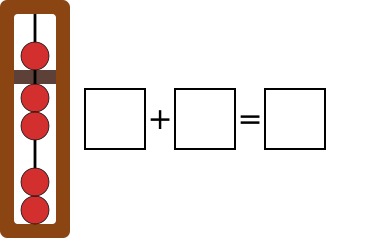
The beads on this one-column abacus represent numbers from \(0\) to \(9\). The upper beads represent \(0\) when they are not touching the bar and \(5\) when they are. The lower beads each represent the value of \(1\).
Review the following examples, then complete the exercises.
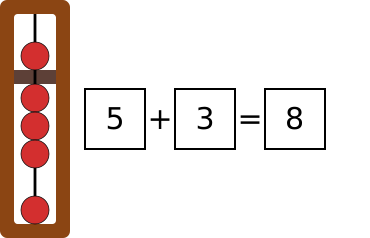
Exercises
1.9 Triceratops, unicorns  and polygons
Some things are called after some inherent number or quantity.
| Name | Meaning | |
|---|---|---|
 |
Triceratops | 3-horned |
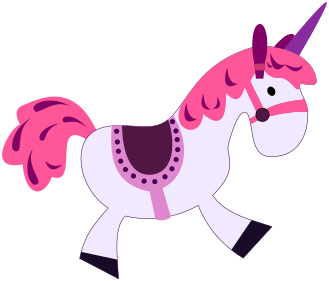 |
Unicorn (Monoceros) | 1-horned |
 |
Octopus | 8-leged |
Another prominent example of things named after a number are geometric figures.
Geometric figures
TipEarth measurement
Geometry is an important branch of mathematics. The word “geometry” comes from the Greek word “γεωμετρία” (geometría) meaning “earth (or land) measurement.”
According to an unverified story, there was an inscription at the entrance of Plato’s Academy that read: “ἀγεωμέτρητος μηδεὶς εἰσίτω”, “Let none but geometers enter here.”
You can think of these notes as your entry ticket.

Polygons are 2-dimensional shapes. Regular polygonons are called after the number of their sides (or angles).
| Number | Greek number | Polygon name | Polygon |
|---|---|---|---|
| \(\color{red}{3}\) | τρία | \(\color{red}{\textbf{tri}}\)angle | 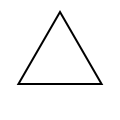 |
| \(\color{red}{4}\) | τέσσερα | square (\(\color{red}{\textbf{tetra}}\)gon) | 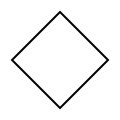 |
| \(\color{red}{5}\) | πέντε | \(\color{red}{\textbf{penta}}\)gon | 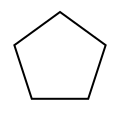 |
| \(\color{red}{6}\) | έξι | \(\color{red}{\textbf{hexa}}\)gon | 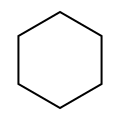 |
| \(\color{red}{7}\) | επτά | \(\color{red}{\textbf{hepta}}\)gon | 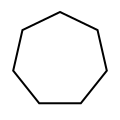 |
| \(\color{red}{8}\) | οκτώ | \(\color{red}{\textbf{octa}}\)gon | 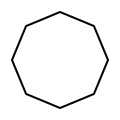 |
| \(\color{red}{9}\) | εννέα | \(\color{red}{\textbf{ennea}}\)gon | 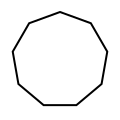 |
| \(\color{red}{10}\) | δέκα | \(\color{red}{\textbf{deca}}\)gon | 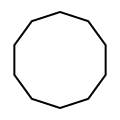 |
If we escape the 2-dimensional world of polygons and move to three dimensions in which we live, we can find polyhedra (meaning “many faces”). A die  or a Rubik’s cube are examples of a polyhedron with 6 faces. The different polyhedra are also named after the number of their faces. The most famous ones are the Platonic solids. There are only five of them, and they are named after the number of their faces.
| Number | Greek Number | Name | |
|---|---|---|---|
| \(\color{red}{4}\) | τέσσερα | \(\color{red}{\textbf{tetra}}\)hedron | 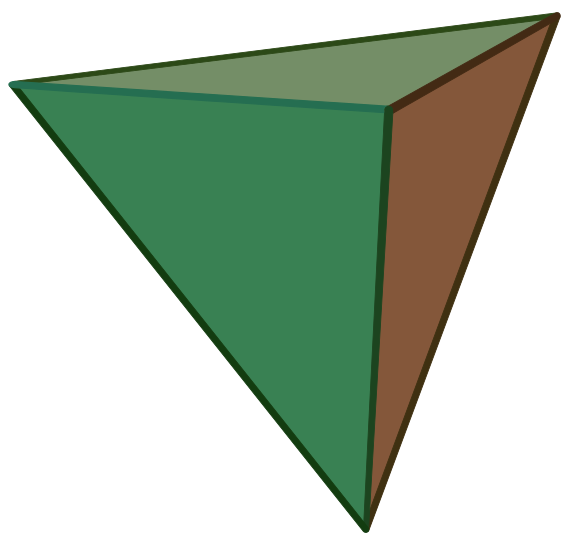 |
| \(\color{red}{6}\) | έξι | \(\color{red}{\textbf{hexa}}\)hedron | 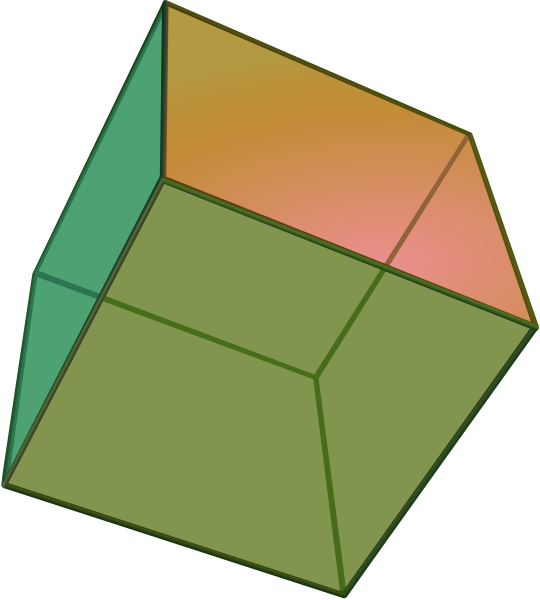 |
| \(\color{red}{8}\) | οκτώ | \(\color{red}{\textbf{octa}}\)hedron | 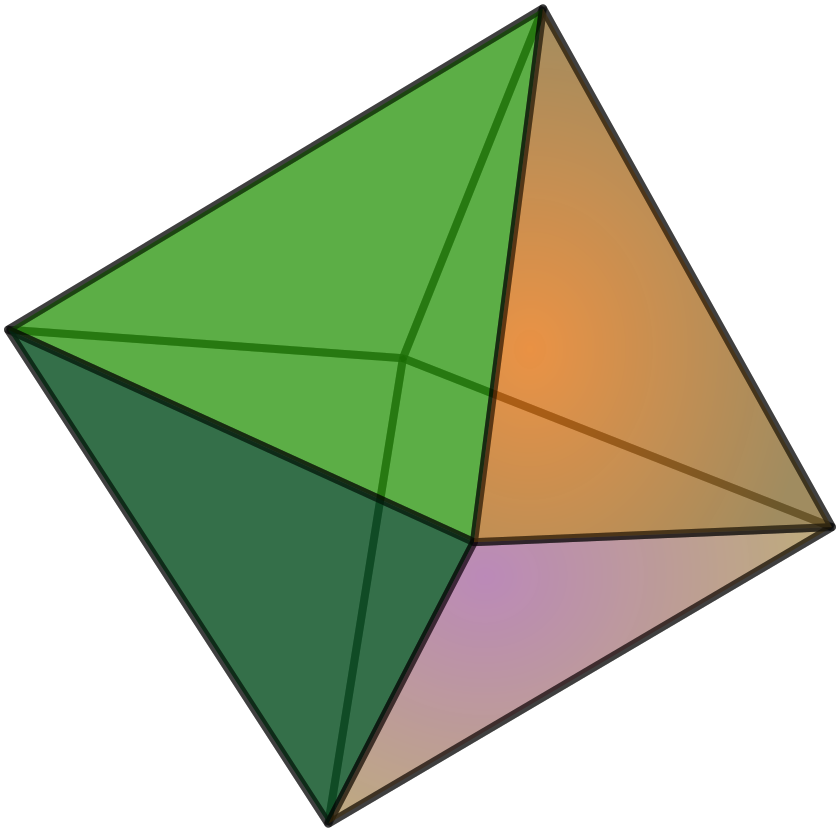 |
| \(\color{red}{12}\) | δώδεκα | \(\color{red}{\textbf{dodeca}}\)hedron | 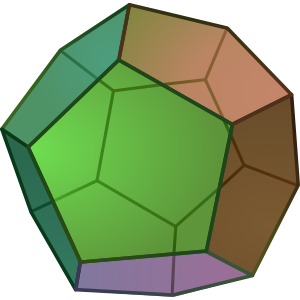 |
| \(\color{red}{20}\) | είκοσι | \(\color{red}{\textbf{icosa}}\)hedron | 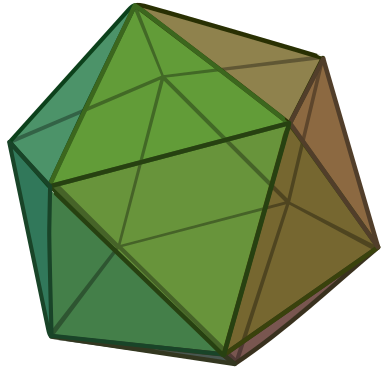 |
TipBeautiful natural numbers
Now that you know what pentagons and triangles are, you can appreciate the beauty of triangular and pentagonal numbers. In general, figural numbers (there are also square, hexagonal, etc.) are beautiful natural numbers that can be arranged in different geometric patterns. For example, the following are the fifth triangular number and the fifth pentagonal number.
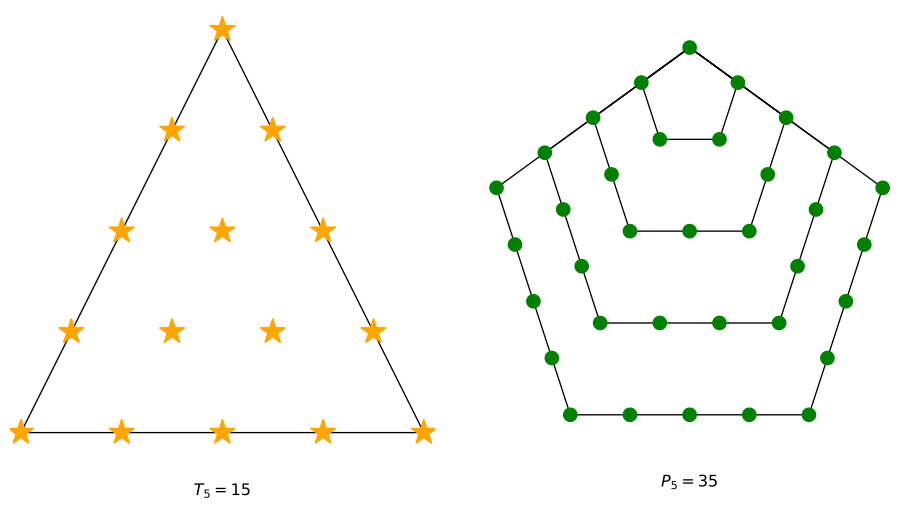
To identify a triangular or pentagonal numbers, you just have to count the number of dots in them.
NoteParent/Educator Tip
This is the Python library for generating and drawing triangular and pentagonal numbers: https://github.com/twaclaw/figural.
1.10 Additional thoughts on addition
Pun intended  .
.
In a way, counting and adding up are the same thing. Each of the counting numbers can be obtained by adding \(\color{blue}{1}\) to the \(\color{red}{\text{previous}}\) one.

That means that if we start with \(0\), the next number is \({\color{red}{0}} + \color{blue}{1}\), the next one is \({\color{red}{1}} + \color{blue}{1}\), and so on.
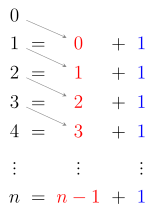
We can say that the counting numbers are generated by \(\color{blue}{1}\). In other words, there is a successor function that takes a number and gives you the next one by adding \(1\).
\[ n \to \text{\style{font-size:1.0em}{🎩}} \to n + \color{blue}{1} \]