5 Counting faster
5.1 Kangaroo math 
Important The Gigantic Turnip
“The Gigantic Turnip” is a cumulative or chain Russian folk tale. In a cumulative tale, the action repeats and builds in a cumulative manner.
The story is about an old man and an old woman who lived in a crooked cottage and owned the following animals:


Read more about this and other cumulative tales at https://wikipedia.org/
The numbers representing the number of each of these animals form an arithmetic progression, or arithmetic sequence, because the difference between any two consecutive numbers is constant. In this case, the common difference is \(1\).
In fact, the natural numbers \(\color{red}{\mathbb{N}}\) are an arithmetic progression as well. As we saw before, the natural numbers can be generated by starting from \(0\) and repeatedly adding \(1\).
Our kangaroo generates the natural numbers by jumping by ones.
There are two things you should know about our kangaroo . First, his name is Joey, and he can jump more than one unit at a time. For example, he can jump two units at a time.
If we follow Joey, we get the sequence:
Joey can, of course, also jump in threes.
On the number line, we can skip the numbers that aren’t part of Joey’s jumps. The sequence remains the same; we are simply changing how we visualize it.
In both cases, the resulting sequence is the same:
Why is Kangaroo math important?
There are two important reasons to learn Kangaroo Math. First, it allows you to count faster. Second, it provides a solid foundation for learning multiplication, division, and exponentiation, as we will see in the next sections.
Counting by jumping two, three, or five units at a time allows you to count faster, just as climbing a staircase becomes quicker when you skip steps.
For example, you can climb a staircase twice as fast if you jump two steps at a time instead of one step at a time.
TipKangaroo math and multiplication
Multiplication is simply a shortcut for counting faster. We will learn later that there are even faster counting tricks.

Exercises
Let’s practice our Kangaroo Math! Write down the sequences generated when Joey jumps \(n\) units at a time.
Based on the following image, answer the following questions:
- When you climb the stairs one step at a time, it takes you \(12\) seconds to reach the top. If you jump \(3\) steps at a time at the same speed, how long would it take you to get to the top?
- If you want to climb the stairs in \(2\) seconds, how many steps would you have to jump at a time?
5.2 Spotting patterns
As we saw earlier, multiplication is repeated addition—the special case that results from adding a value to itself multiple times. For example:
\[ \begin{aligned} \underbrace{3+3+3+3+3}_{{\color{red}{5}} \text{ times}} &= {\color{red}{5}} \times 3 = 15\\ \end{aligned} \]
Adding \(3\) to itself five times is the same as counting by threes five times.
That’s the connection between multiplication and Kangaroo Math!
To count faster, we must learn to do two related yet independent things.
- Spot a pattern in the objects we want to count.
- Practice and memorize—or rather, internalize—the results of common multiplications.
In the next section, we will start learning how to master multiplication results. For now, focus on spotting patterns in the objects you want to count.
Exercises
Try to identify the pattern in the following quantities, then write it down as a multiplication.
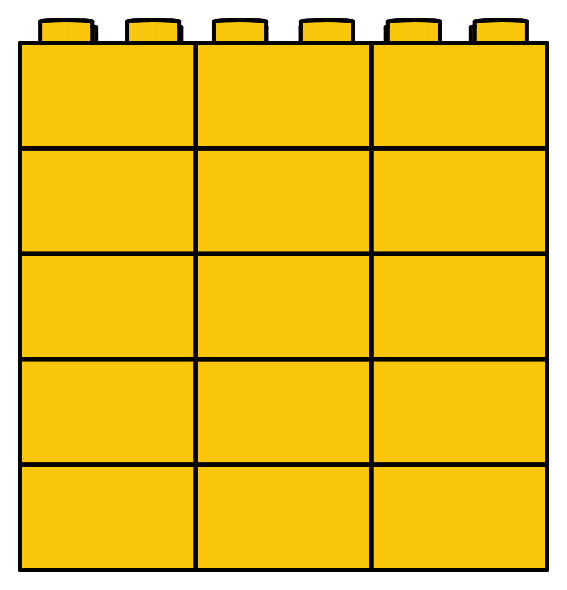
Here we have \(5\) rows of \(3\) bricks each. The total number of bricks is then \(5 \times 3\).
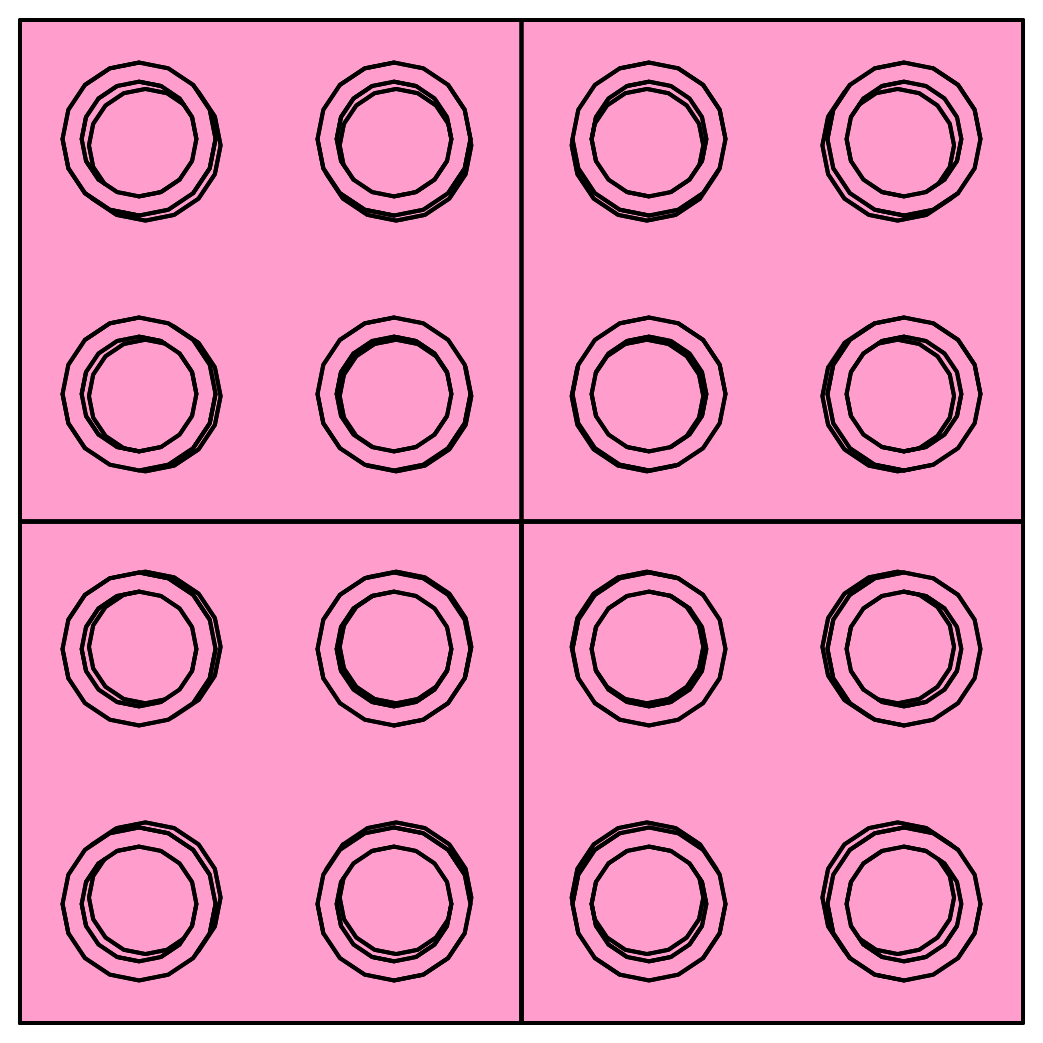
Here the total number of pink bricks is \(\boxed{\phantom{5}} \times \boxed{\phantom{3}}\).
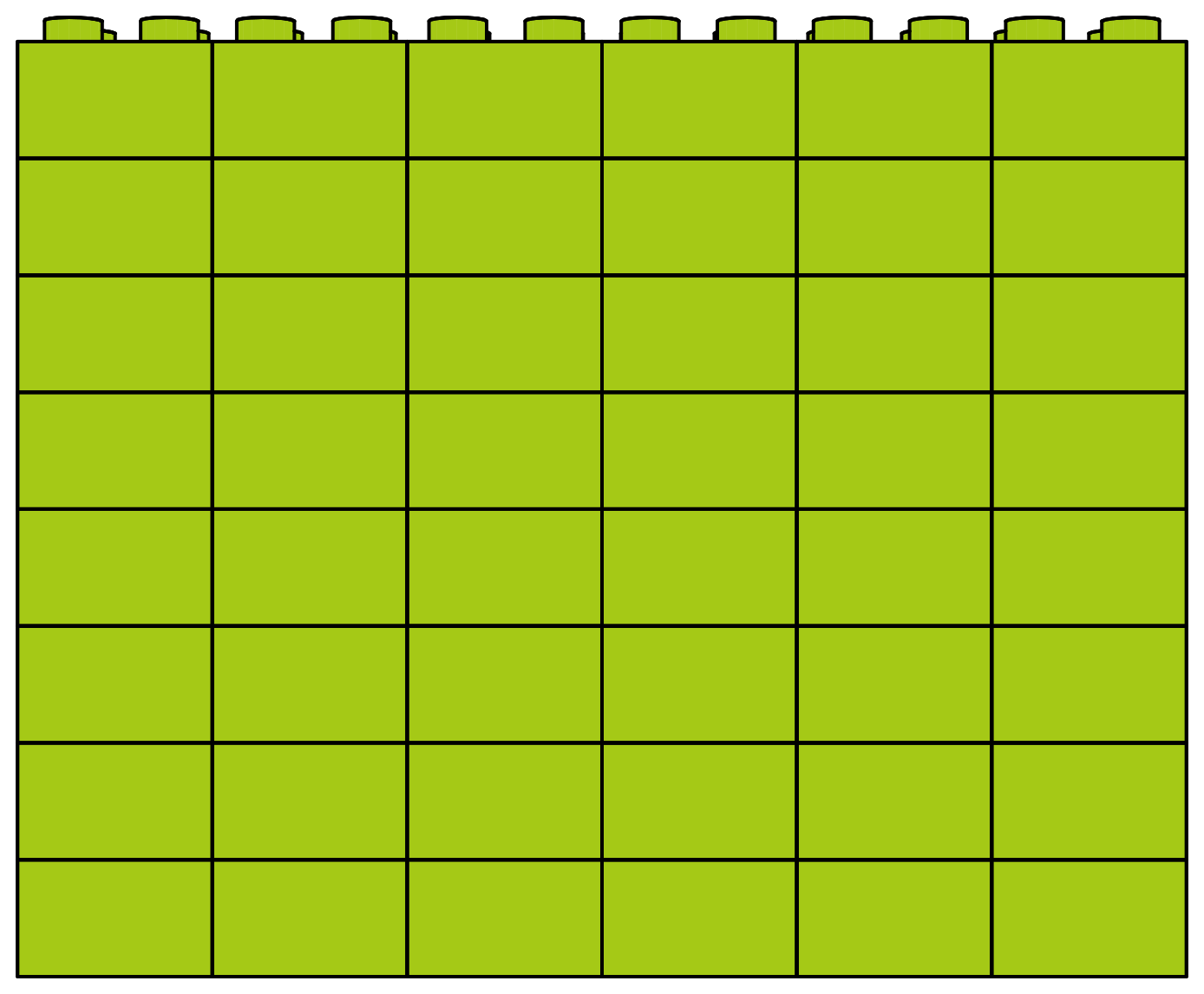
Here the total number of green bricks is \(\boxed{\phantom{5}} \times \boxed{\phantom{3}}\).
There are \(6\) rows of \(4\) penguins each, plus an extra row with \(3\) penguins. Note that the last row cannot be included in the multiplication because it has a different number of penguins than the other rows.
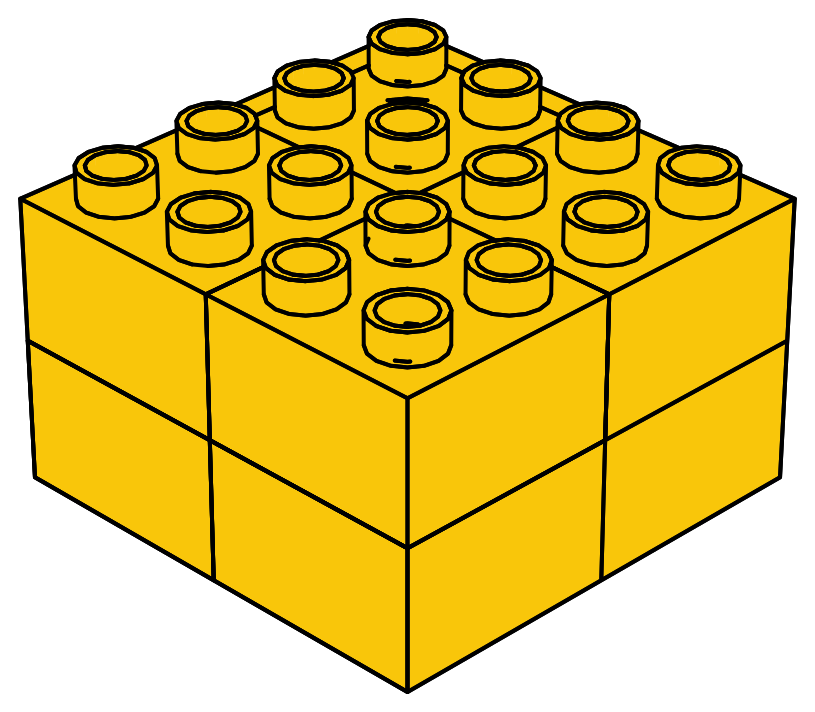
There are \(2\) layers of \(2\) rows of \(2\) bricks each. The total number of bricks is then \(2 \times 2 \times 2\).
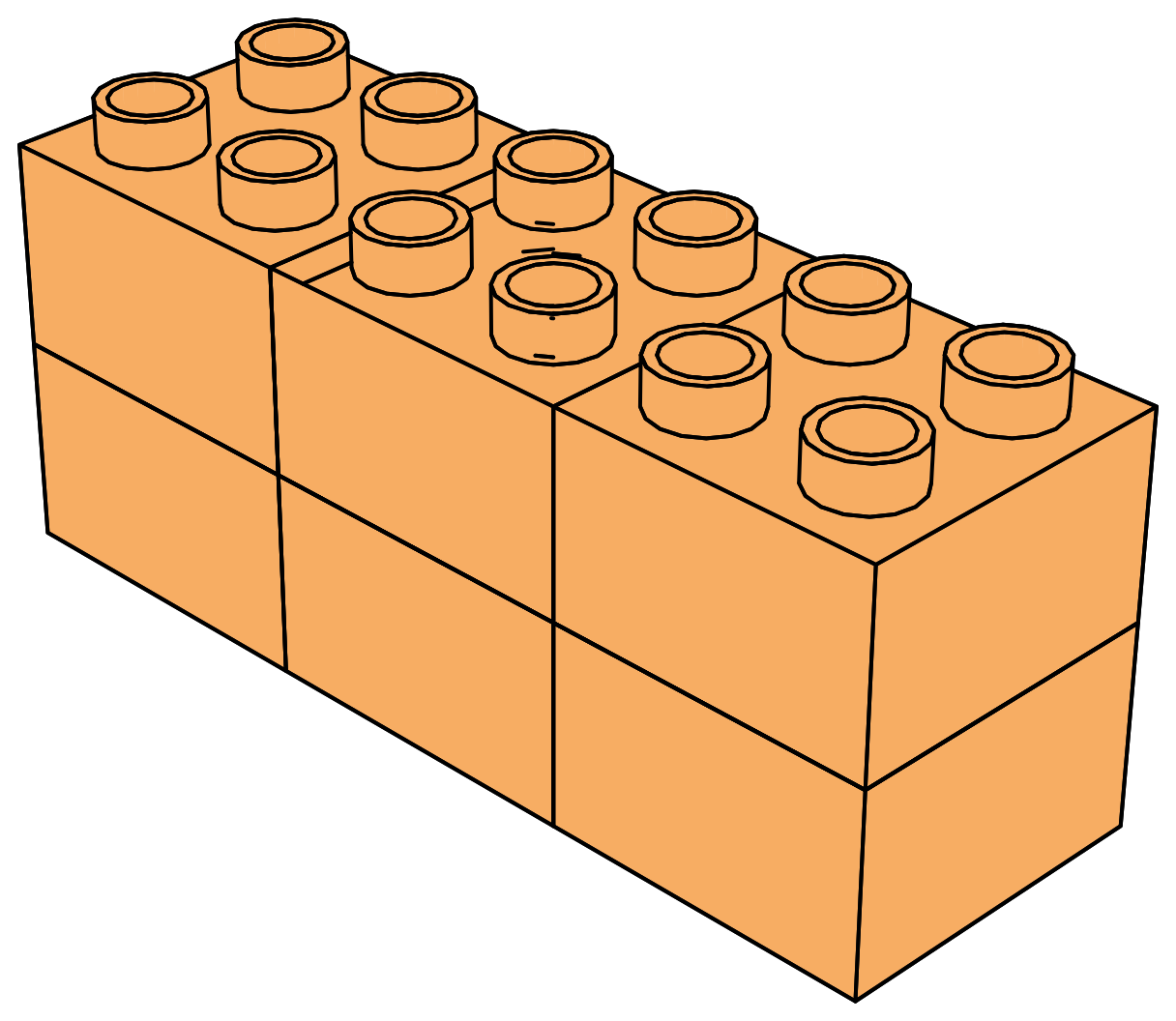
The total number of orange bricks is \(\boxed{\phantom{5}} \times \boxed{\phantom{3}} \times \boxed{\phantom{2}}\).
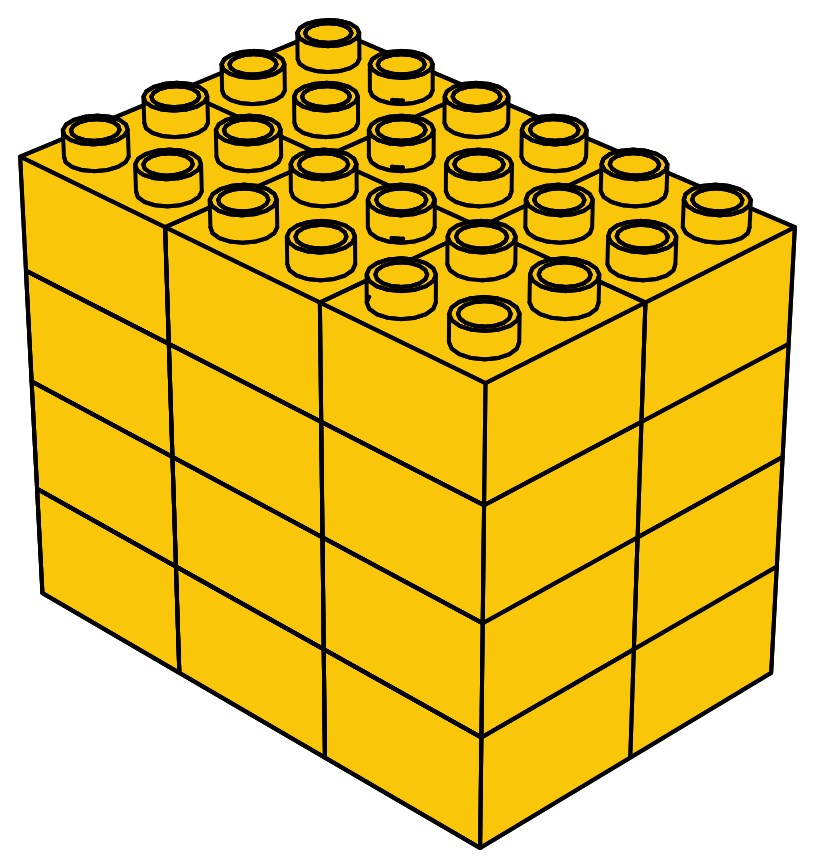
The total number of yellow bricks is \(\boxed{\phantom{5}} \times \boxed{\phantom{3}} \times \boxed{\phantom{2}}\).
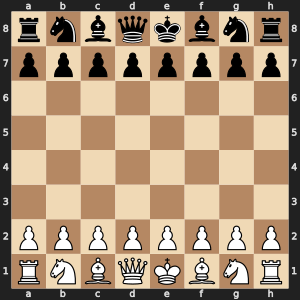
Based on the chessboard below, answer the following questions. Can you express your answers using multiplication?
- How many squares are there in total on the chessboard?
- How many white pieces are on the chessboard?
- How many pieces are there in total (white and black)?
- How many squares are empty?
5.3 Multiplication tables
Important The Arabian Nights of Numbers
Beremiz Samir is a gifted mathematician who can count faster than anyone else. He can look at a flock of birds or a herd of camels and instantly tell you how many there are. His mathematical genius guides him through exciting and dangerous adventures as he solves puzzles and riddles, helps people, and finds love. Read more about Beremiz Samir in The Man Who Counted by Malba Tahan.
We can also learn to count quickly. As we saw in the previous section, the first step is identifying patterns. The second step is to practice and memorize the results of basic multiplication. Mastering these calculations will give you superpowers and lay the groundwork for algorithms for multiplying larger numbers.
We will use tables like the one below to practice our multiplication skills. Don’t worry about memorizing them; with practice, you will get better.
These tables are very similar to the ones we saw before for addition when defining groups.
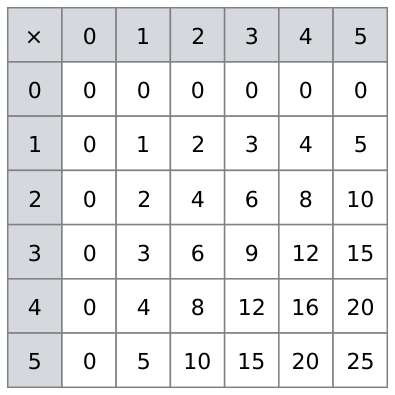
The values in the table are the products of multiplying the row and column numbers. For example, to find the result of \(3 \times 4\), first locate the row with the number \(3\), then the column with the number \(4\). The cell where the row and column intersect contains the product, which is \(12\) in this case. Therefore, \(3 \times 4 = 12\).
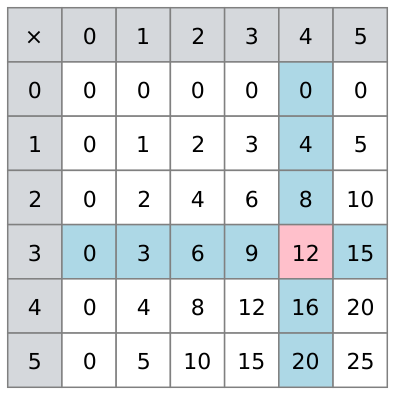
In the same way, we can compute for instance \(2 \times 5\).
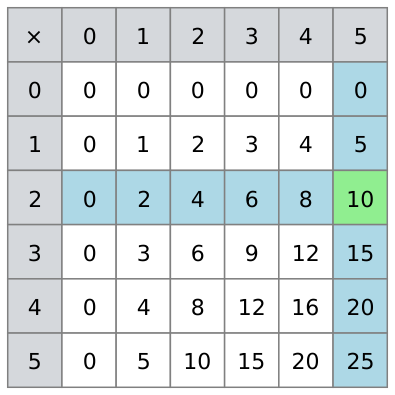
If you look closely, you will see that the results of previous multiplications appear twice in the table.
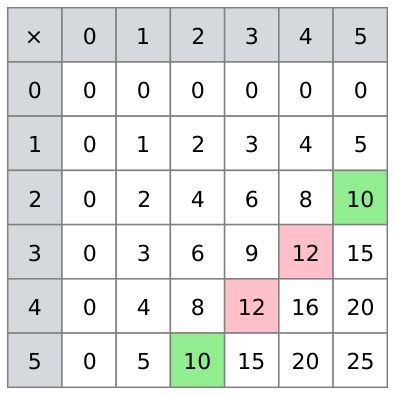
Those values appear twice because multiplication, like addition, is commutative.
\[ a \times b = b \times a \]
In previous examples, we saw that \(2 \times 5 = 5 \times 2\) and \(3 \times 4 = 4 \times 3\). This property makes the multiplication table symmetric with respect to the diagonal.
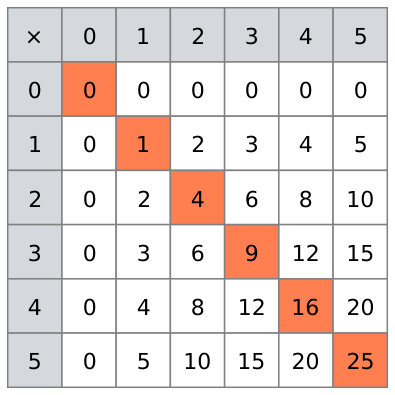
What does it mean? It means good news! We only need to learn one half of the table: either the upper or lower triangle. Hooray! 
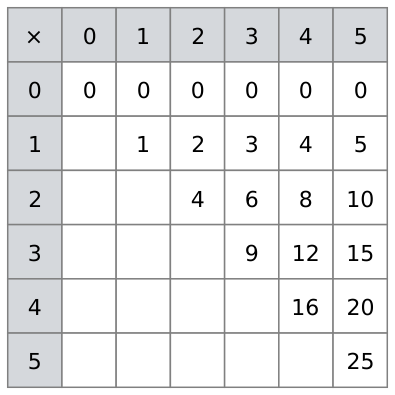
However, keep in mind that the product you want to calculate may not be directly accessible, so you may need to use the commutative property to find it. For instance, if you want to calculate \(5 \times 2\), you could look for \(2 \times 5\) instead.
What are the sequences of each row and column?
By looking at one row or column in particular, such as the sequence of values in row \(n\), which is the same as the sequence of values in column \(n\), we obtain an arithmetic progression of multiples of \(n\). For example, the sequence of values in row \(3\) is the same as the sequence of values in column \(3\). We obtain the sequence \(0, 3, 6, 9, 12, 15, 18, \ldots\).
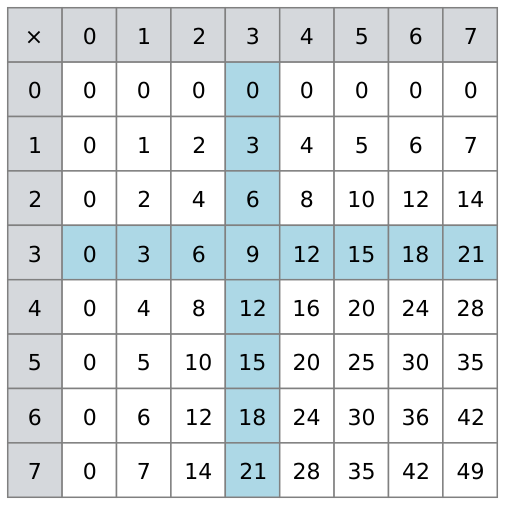
In other words, the values in a given row or column correspond to the series in Kangaroo Math when Joey jumps \(n\) units at a time.
What are the values in the diagonal?
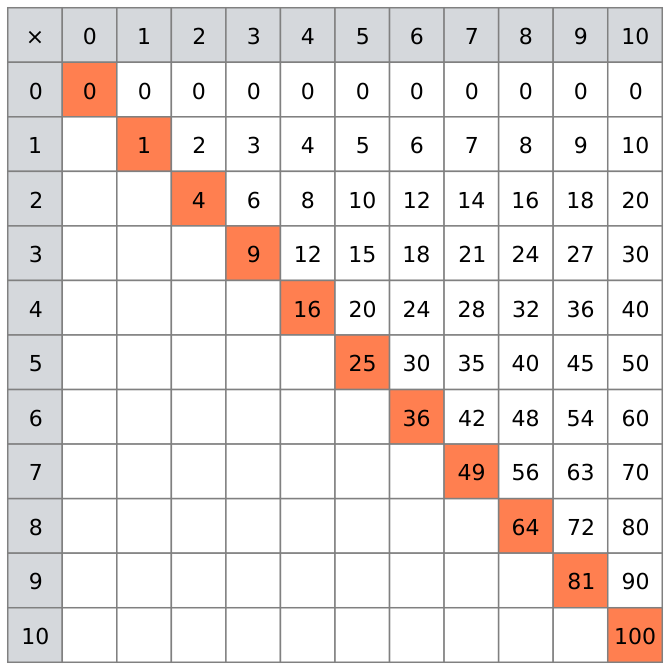
These are the results of multiplying a number by itself. We will soon learn that this operation is called squaring a number, and the result is called the square of the number.
\[ \underbrace{a \times a}_{{\color{red}{2}} \text{ times}} = a^{{\color{red}{2}}} \]
For instance:
\[\begin{align*} 1 \times 1 &= 1^{{\color{red}{2}}} = 1\\ 2 \times 2 &= 2^{{\color{red}{2}}} = 4\\ 3 \times 3 &= 3^{{\color{red}{2}}} = 9\\ 4 \times 4 &= 4^{{\color{red}{2}}} = 16\\ 5 \times 5 &= 5^{{\color{red}{2}}} = 25\\ 6 \times 6 &= 6^{{\color{red}{2}}} = 36\\ 7 \times 7 &= 7^{{\color{red}{2}}} = 49\\ 8 \times 8 &= 8^{{\color{red}{2}}} = 64\\ 9 \times 9 &= 9^{{\color{red}{2}}} = 81\\ 10 \times 10 &= 10^{{\color{red}{2}}} = 100\\ \vdots \\ \end{align*}\]
Exercises
Based on this multiplication table:
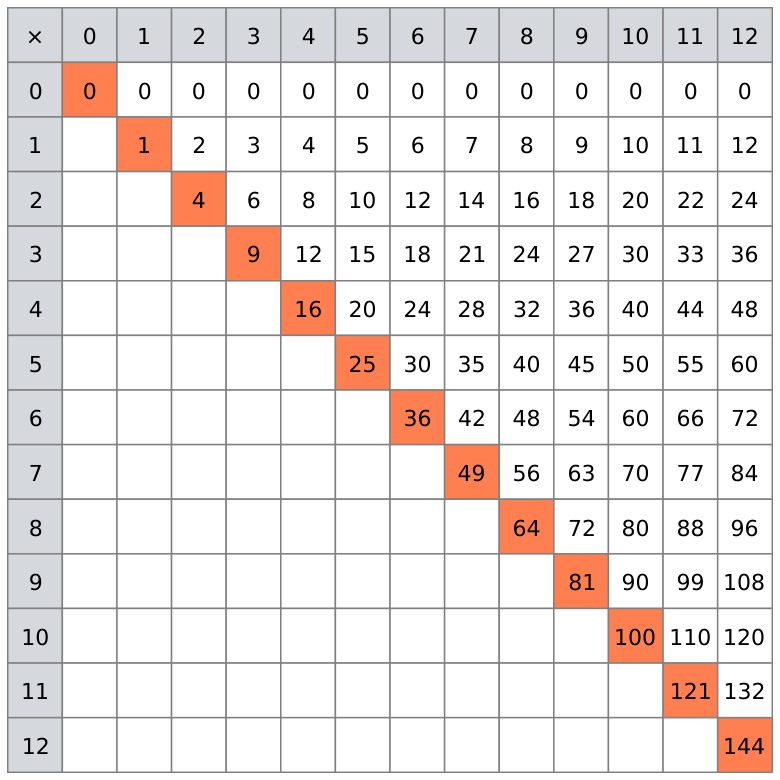
Calculate the following products:
\[\begin{align*} 2 \times 7 &= \boxed{\phantom{123}}\\ 7 \times 2 &= \boxed{\phantom{123}}\\ 11 \times 11 &= \boxed{\phantom{123}}\\ 12 \times 12 &= \boxed{\phantom{123}}\\ 5 \times 9 &= \boxed{\phantom{123}}\\ 7 \times 6 &= \boxed{\phantom{123}}\\ 11 \times 1 &= \boxed{\phantom{12}}\\ 7 \times 1 &= \boxed{\phantom{123}}\\ 8 \times 0 &= \boxed{\phantom{123}}\\ 12 \times 0 &= \boxed{\phantom{123}}\\ 11^2 &= \boxed{\phantom{123}}\\ 12^2 &= \boxed{\phantom{123}}\\ 10^2 &= \boxed{\phantom{123}}\\ 4^2 &= \boxed{\phantom{123}}\\ \end{align*}\]
- What happens when you multiply a number by \(0\)?
- What happens when you multiply a number by \(1\)?
- Write down the arithmetic series generated by counting in sevens.
The following are are the rules for multiplying negative numbers:
- If the signs are the same (both positive or both negative), the result is positive. For example, \((-2) \times (-3) = 6\) and \(2 \times 3 = 6\).
- If the signs are different (one positive and one negative), the result is negative. For example, \((-2) \times 3 = -6\) and \(2 \times (-3) = -6\).
In other words, the sign is the exclusive or (XOR), or the modulo \(2\) sum of the signs of the factors.
\[\begin{align*} 2 \times -7 &= \boxed{\phantom{-14}}\\ 7 \times -2 &= \boxed{\phantom{-14}}\\ -11 \times -11 &= \boxed{\phantom{123}}\\ 12 \times 12 &= \boxed{\phantom{123}}\\ 5 \times -9 &= \boxed{\phantom{-45}}\\ 7 \times -6 &= \boxed{\phantom{123}}\\ 11 \times -1 &= \boxed{\phantom{12}}\\ -7 \times -1 &= \boxed{\phantom{123}}\\ 2 \times 0 &= \boxed{\phantom{123}}\\ -2 \times 0 &= \boxed{\phantom{123}}\\ (-10)^2 &= \boxed{\phantom{123}}\\ (-4)^2 &= \boxed{\phantom{123}}\\ \end{align*}\]
5.4 Exponentiation
As we saw earlier, repeated addition is multiplication. For example, \(4\times 7\) is equivalent to adding \(7\) four times: \(7+7+7+7\). In the general case, we have:
\[ \begin{aligned} \underbrace{a + a + \cdots + a}_{{\color{red}{n}} \text{ times}} &= {\color{red}{n}} \times a \end{aligned} \]
Because mathematics is recursive, much like the Gigantic Turnip, we can now ask ourselves the following question:
As we’ve seen, multiplying a number by itself is called squaring the number. We symbolize this with a cute little superscript.
\[ a \times a = a^2 \]
This little number represents how many times we multiply a number by itself. It is called the exponent.
\[ \begin{aligned} \underbrace{a \times a \times \cdots \times a}_{{\color{red}{n}} \text{ times}} &= a^{\color{red}{n}} \end{aligned} \]
Just as we call it “squaring” when the exponent is two, we call it “cubing” when the exponent is three because we are defining the volume of a cube.
Here are some examples of exponentiation:
\[\begin{align*} 2^2 &= 2 \times 2 &= 4 \\ 2^3 &= 2 \times 2 \times 2 &= 8 \\ 4^2 &= 4 \times 4 &= 16 \\ 3^3 &= 3 \times 3 \times 3 &= 27 \end{align*}\]
5.5 Exponentiation of 10
A special case of exponentiation occurs in the decimal system when the base is \(10\).
\[\begin{align*} 10^1 &= 10 &= 10 \\ 10^2 &= 10 \times 10 &= 100 \\ 10^3 &= 10 \times 10 \times 10 &= 1000 \\ 10^4 &= 10 \times 10 \times 10 \times 10 &= 10000 \end{align*}\]
In general we have:
\[\begin{aligned}
\underbrace{10 \times 10 \times \cdots \times 10}_{{\color{red}{n}} \text{ times}} &= 10^{\color{red}{n}} & 1\underbrace{\color{red}{000\cdots 000}}_{{\color{red}{n}} \text{ zeros}}
\end{aligned}\]
Below is a list of the first powers of \(10\):
\[\begin{align*} 10^0 &= 1 \\ 10^1 &= 10 \\ 10^2 &= 100 \\ 10^3 &= 1000 \\ 10^4 &= 10000\\ 10^5 &= 100000 \\ \end{align*}\]
Notice that \(10^0\) is equal to \(1\). This is true for any number, not just \(10\). \(a^0=1\).
As I mentioned before, mathematics is recursive.
We will stop at exponentiation. As an interesting fact, repeated exponentiation is called tetration, which allows us to build towers of numbers like this:
\[ 2^{3^{3^3}} \]
Exercises
Calculate the following powers:
\[\begin{align*} 2^3 &= \boxed{\phantom{8}} \\ 2^4 &= \boxed{\phantom{16}} \\ 3^2 &= \boxed{\phantom{9}} \\ 10^0 &= \boxed{\phantom{1}} \\ 10^1 &= \boxed{\phantom{10}} \\ 10^5 &= \boxed{\phantom{100000}} \\ 10^4 &= \boxed{\phantom{10000}} \\ \end{align*}\]
5.6 Positional number system revisited
Just as calculating powers of \(10\) is easy, so too is multiplying a digit by a power of \(10\).
\[\begin{align*} 3 \times 10^2 &= 3 \times 100 = 300 \\ 7 \times 10^3 &= 7 \times 1000 = 7000\\ 2 \times 10^4 &= 2 \times 10000 = 20000 \\ 3 \times 10^5 &= 3 \times 100000 = 300000 \end{align*}\]
Do you see the pattern?
Now that we have this information, we can finally formalize the positional number system.
Remember that in a positional number system, the value of a digit depends on its position.
\[ \underbrace{\color{blue}{3}}_{2}\underbrace{\color{red}{3}}_{1}\underbrace{\color{Black}{3}}_{0} \]
The same number can be written as:
\[ {\color{Blue}{3}}{\color{Red}{3}}{\color{Black}{3}} = {\color{Blue}{3}} \times 10^2 + {\color{Red}{3}} \times 10^1 + {\color{Black}{3}} \times 10^0 \]
Therefore, we can write the same number as the sum below:
\[ \begin{aligned} {\color{Blue}{3}}00 \\ +{\color{Red}{3}}0 \\ +{\color{Black}{3}}\\ \hline {\color{Blue}{3}}{\color{Red}{3}}{\color{Black}{3}} \end{aligned} \]
Here is another example:
\[ {\color{Blue}{1}}{\color{Red}{5}}{\color{Black}{0}} = {\color{Blue}{1}} \times 10^2 + {\color{Red}{5}} \times 10^1 + {\color{Black}{0}} \times 10^0 \]
\[ \begin{aligned} {\color{OliveGreen}{4}}000 \\ +{\color{Blue}{1}}00 \\ +{\color{Red}{0}}0 \\ +{\color{Black}{1}}\\ \hline {\color{OliveGreen}{4}}{\color{Blue}{1}}{\color{Red}{0}}{\color{Black}{1}} \end{aligned} \]
In general, the value of each digit \(d_i\) is given by:
\[ d_i \times 10^{p_i} \]
Where \(p_i\) is the position of the digit \(d_i\) in the number, starting at \(0\) for the rightmost digit.
TipFun Fact
This holds true for any base, not just \(10\), and can be extended to non-integer numbers as well.
Exercises
Write each of the following numbers as its constituent parts:
\[\begin{align*} 123 &= 100 + 20 + 3 \\ 100 & = 100 + 0 + 0 \\ 4567 &= 4000 + 500 + 60 + 7 \\ 17 &= \boxed{\phantom{10}} + \boxed{\phantom{1}} \\ 23 &= \boxed{\phantom{20}} + \boxed{\phantom{3}} \\ 1001 &= \boxed{\phantom{1000}} + \boxed{\phantom{0}} + \boxed{\phantom{0}} + \boxed{\phantom{1}}\\ 1000 &= \boxed{\phantom{1000}} + \boxed{\phantom{0}} + \boxed{\phantom{0}} + \boxed{\phantom{0}}\\ 555 &= \boxed{\phantom{500}} + \boxed{\phantom{50}} + \boxed{\phantom{5}}\\ 171 &= \boxed{\phantom{100}} + \boxed{\phantom{70}} + \boxed{\phantom{1}}\\ 79 &= \boxed{\phantom{70}} + \boxed{\phantom{9}}\\ 42 &= \boxed{\phantom{40}} + \boxed{\phantom{2}}\\ 10381 &= \boxed{\phantom{10000}} + \boxed{\phantom{0}} + \boxed{\phantom{300}} + \boxed{\phantom{80}} + \boxed{\phantom{1}}\\ \end{align*}\]
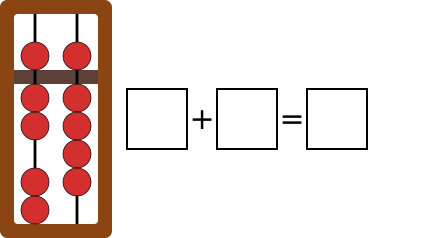
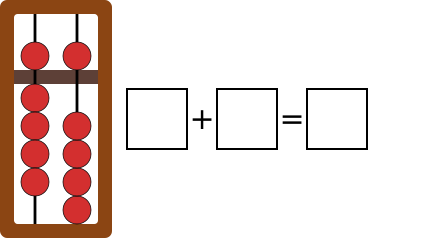
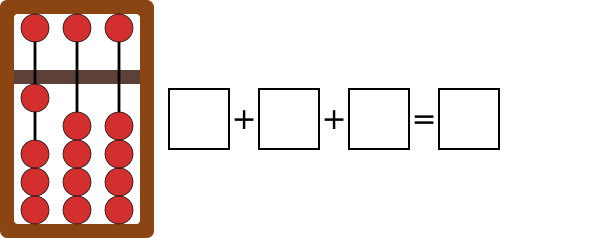
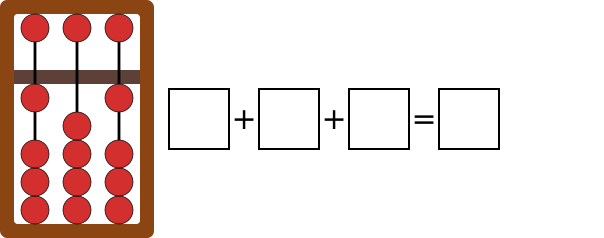
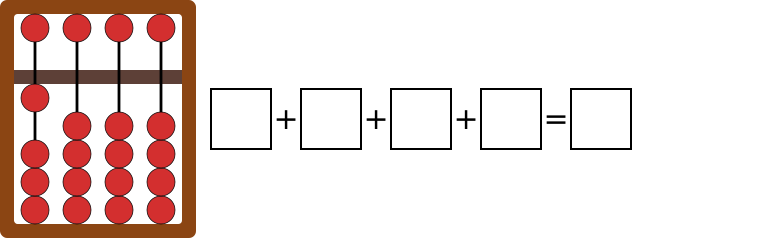
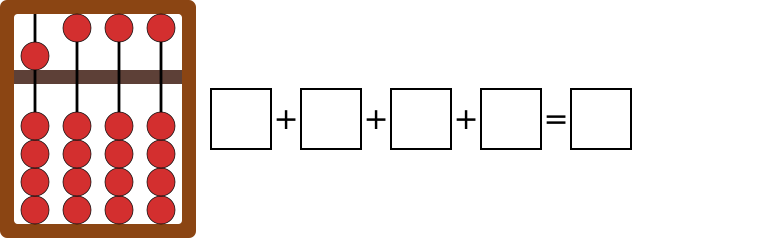
We saw in section Section 1.8 how to represent values using a single-column Soroban abacus.
Here are some examples to refresh your mamory:
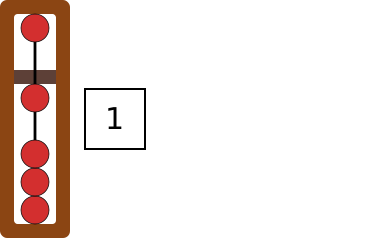
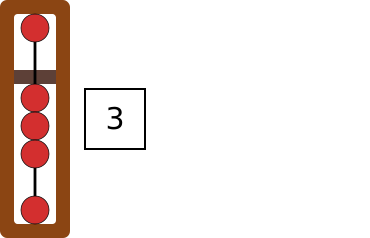
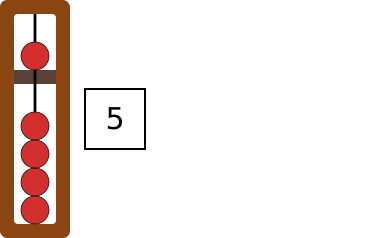
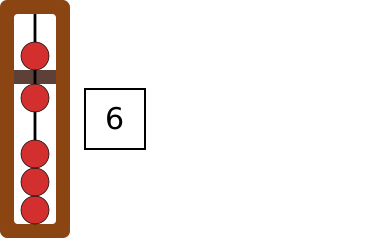
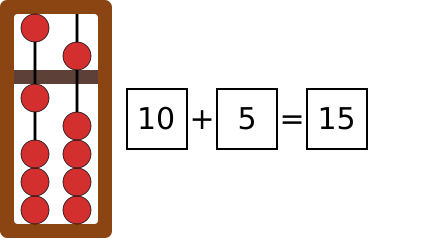
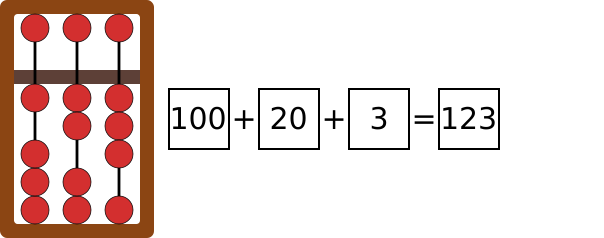
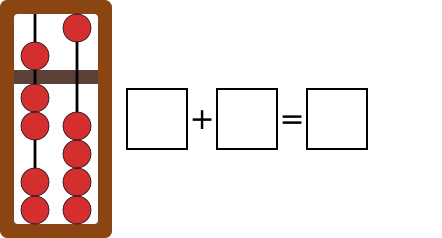
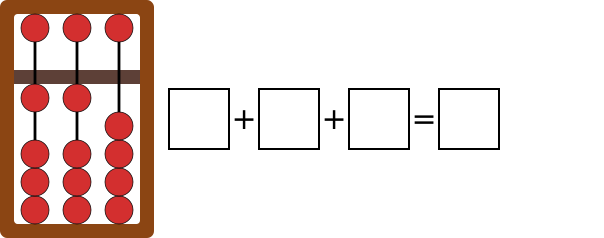
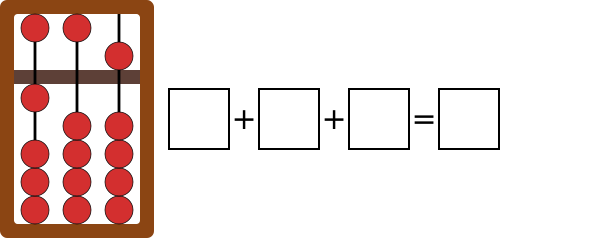
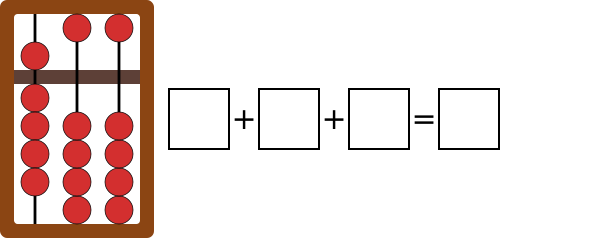
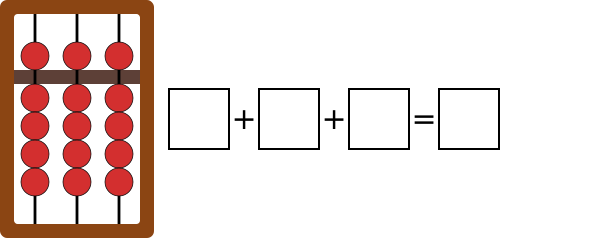
The Soroban abacus follows the same logic as the positional number system, meaning that the first column to the right represents units, that is the value multiplied by \(10^0\), the next column represents tens, that is the value multiplied by \(10^1\), the next column represents hundreds, that is the value multiplied by \(10^2\), and so on.
Complete the following representations:
5.7 Division
Imagine that you are playing a card game with your friends. It could be Uno, The Mind, or any other card game in which each player starts with an equal number of cards.
Let’s say the game has \(12\) cards and \(3\) are three players. Initially, each player has \(0\) cards.
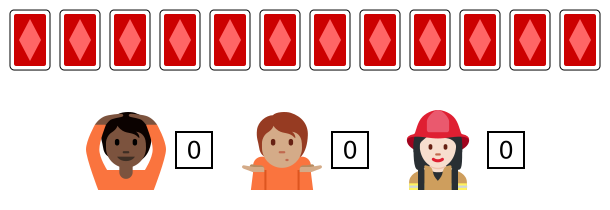
Start by giving each player one card at a time. After the first round, each player will have \(1\) card.
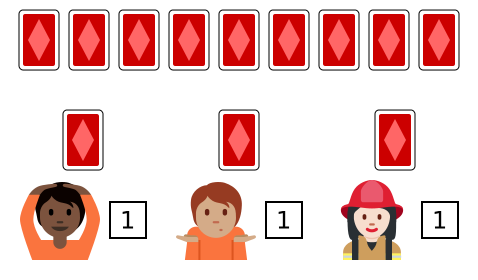
After the second round, each player will have \(2\) cards.
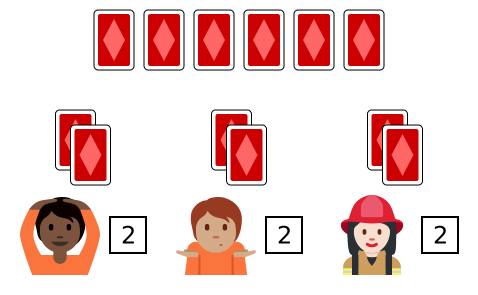
After the third round, each player will have \(3\) cards.
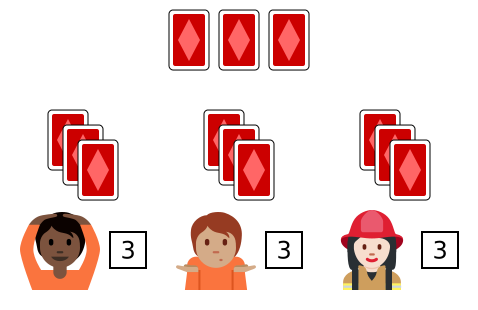
This continues until all cards are distributed.
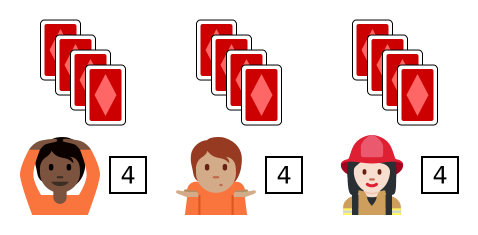
By the end, every player has \(4\) cards.
This process of splitting into equal parts is called division. In the previous example, we said that \(12\) cards divided among \(3\) players equals \(4\) cards per player. There are different ways to write this.
\[ 12 \div 3 = 12/3 = \frac{12}{3} = 4 \]
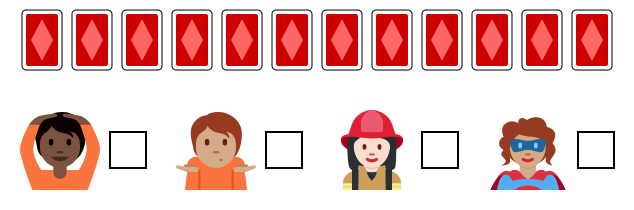
If we follow the same process of giving out the cards one by one, each player ends up with \(3\) cards.
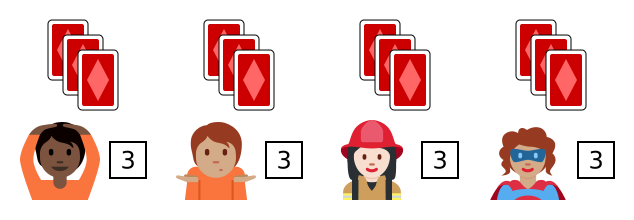
This can be written as follows:
\[ 12 \div 4 = 12/4 = \frac{12}{4} = 3 \]
What is division?
Just as subtraction is the inverse of addition, division is the inverse of multiplication.
To see this, let’s review the previous results and try to connect them with multiplication. We can write the first result as follows:
\[ \begin{align*} \frac{12}{3} &= 4 \\ 12 &= 3 \times 4 \end{align*} \]
For example, we determined that there are \(5\times 3 = 15\) LEGO bricks in the following image:
We can also work backwards and ask, given that there are \(15\) LEGO bricks, how many rows of \(3\) bricks can we build? \(15/3 = 5\). How many columns of \(5\) bricks can we build? \(15/5 = 3\).
In general, if an integer \(c\) is the product of two integers \(a\) and \(b\),
\[ c = a \times b \]
We known than \(c\) can be divided by both \(a\) and \(b\):
\[\begin{align*} c \div b &= a \\ c \div a &= b \end{align*}\]
This means that we can use multiplication tables to find division results.
For example, if I asked you to solve the following division problem:
\[ \frac{35}{5} = \boxed{?} \]
We can look at the multiplication table to find the values where the product is \(35\). Then, we can check if any of the columns or rows of those values contains a \(5\).
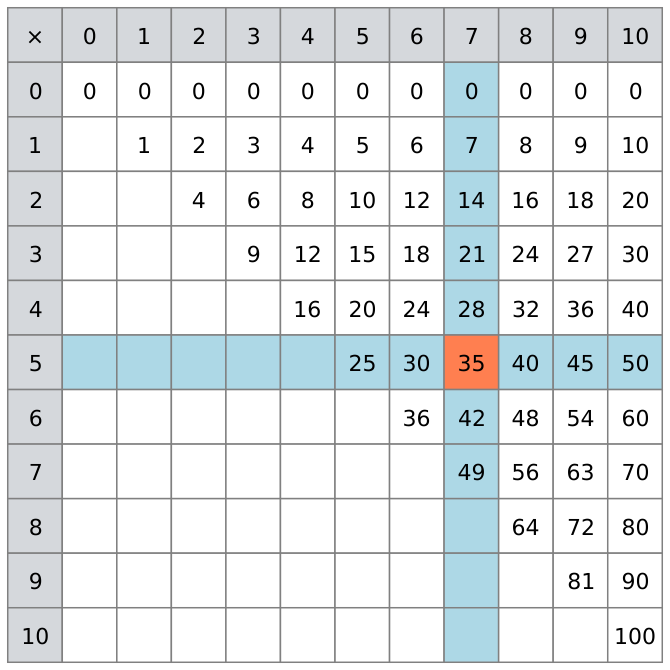
Since \(35\) is the product of \(5\) and \(7\), we can conclude that \(35 \div 5 = 7\).
Exercises
- If I have \(20\) LEGO bricks, how many towers of \(4\) bricks each can I build?
- If my grandparents bring me and my sister \(8\) bombons, and we want to split them equally, how many will each of us get?
- Compute the following divisions using the multiplication table:
\[\begin{align*} 36 \div 6 &= \boxed{\phantom{6}} \\ 48 \div 8 &= \boxed{\phantom{6}} \\ 56 \div 7 &= \boxed{\phantom{8}} \\ 63 \div 9 &= \boxed{\phantom{7}} \\ 72 \div 8 &= \boxed{\phantom{9}} \\ 100 \div 10 &= \boxed{\phantom{10}} \\ \end{align*}\]
- In the following games, how many cards does each player get?
21 cards divided by 3 players:
20 cards divided by 4 players: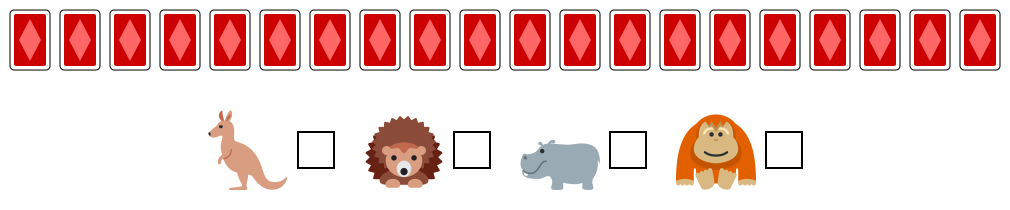
15 cards divided by 5 players: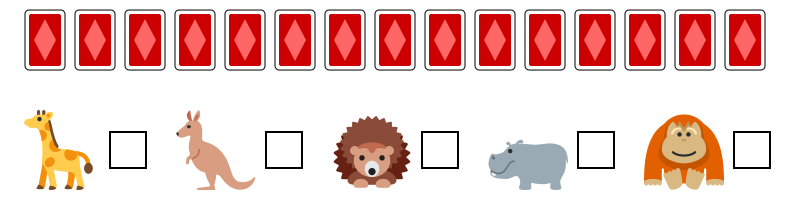
9 cards divided by 3 players: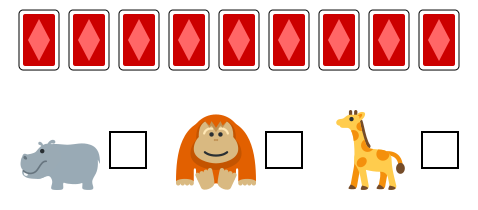
5.8 Multiplying and dividing by powers of 10
Multiplying and dividing by powers of \(10\) is a special case that can be done quickly by shifting the digits of a number. This is because \(10\) is the base of our decimal number system. The same idea works in any base and is how computers efficiently perform multiplication and division by powers of \(2\).
Given a number with multiple digits, \(d_1d_2\dots d_n,\) and a power of \(10\) to multiply by, the result is simply the original number shifted to the left by the exponent of \(10\) (the number of zeros in the power of ten) for multiplication and to the right for division.
Remember, a power of \(10\) is a \(1\) followed by \(0\text{s}\).
\[\begin{aligned}
\underbrace{10 \times 10 \times \cdots \times 10}_{{\color{red}{n}} \text{ times}} &= 10^{\color{red}{n}} & 1\underbrace{\color{red}{000\cdots 000}}_{{\color{red}{n}} \text{ zeros}}
\end{aligned}\]
This is what happens when we multiply a general number \(d_1d_2\dots d_n\) by a power of \(10\):
\[ \begin{aligned} \underbrace{d_1d_2\dots d_n}_{\text{number}} \times 10^{\color{red}{n}} &= \underbrace{d_1d_2\dots d_n}_{\text{number}} \times \underbrace{1\color{red}{0\cdots 0}}_{{\color{red}{n}} \text{ zeros}} \\ &= \underbrace{d_1d_2\dots d_n\color{red}{0\cdots 0}}_{\text{number with $n$ zeros at the end}} \end{aligned} \]
The following examples should make this concept clearer.
\[ \begin{aligned} {\color{OliveGreen}5} \times 10^{\color{red}1} &= {\color{OliveGreen}5} \times 1{\color{red}0} = {\color{OliveGreen}5}{\color{red}0} \\ {\color{OliveGreen}5} \times 10^{\color{red}2} &= {\color{OliveGreen}5} \times 1{\color{red}00} = {\color{OliveGreen}5}{\color{red}00} \\ {\color{OliveGreen}753} \times 10^{\color{red}4} &= {\color{OliveGreen}753} \times 1{\color{red}0000} = {\color{OliveGreen}753}{\color{red}0000} \end{aligned} \]
Exercises
Perform the following computations:
\[\begin{align*} 2 \times 10 &= \boxed{\phantom{20}}\\ 20 \times 10 &= \boxed{\phantom{200}}\\ 123 \times 1000 &= \boxed{\phantom{123000}}\\ 123 \times 10^3 &= \boxed{\phantom{123000}}\\ 57 \times 10^2 &= \boxed{\phantom{5700}}\\ 21 \times 100 &= \boxed{\phantom{2100}}\\ 1000 \div 10 &= \boxed{\phantom{100}}\\ 1200 \div 100 &= \boxed{\phantom{12}}\\ 5700 \div 10 &= \boxed{\phantom{570}}\\ 5700 \div 10^2 &= \boxed{\phantom{57}}\\ \end{align*}\]