6 Multiplication and geometry
We began our journey of learning multiplication by discerning patterns. Then, we learned how to express those patterns as the product of two or three integers. Finally, we learned how to compute those products using multiplication tables. Now, we are cycling back and formalizing the idea of patterns, making a link between multiplication and geometry. Specifically, we are exploring how multiplying two natural numbers produces a two-dimensional object called a plane and how multiplying three natural numbers produces a three-dimensional object called a volume.
Remember that in Section 2.6, we defined a dimension as one of the directions in which you can move. Here, \(N\) represents the number of dimensions.
| \(N\) | Object | Symbol | How can we move? | How to construct? |
|---|---|---|---|---|
| 0 | Point | \(\color{red}{\bullet}\) | We cannot move. | |
| 1 | Line | \(\color{red}{\rule{2cm}{0.8pt}}\) | We can move only forward and backward. | \(d\) |
| 2 | Plane |  |
We can move forward and backward, and also left and right. | \(d \times d = d^2\) |
| 3 | Volume |  |
We can move left, right, forward, backward, and jump up and down. | \(d \times d \times d = d^3\) |
An area is a measurement that indicates the size of a two-dimensional object. For instance, the area of the wall pictured below equals the number of LEGO bricks that comprise it.
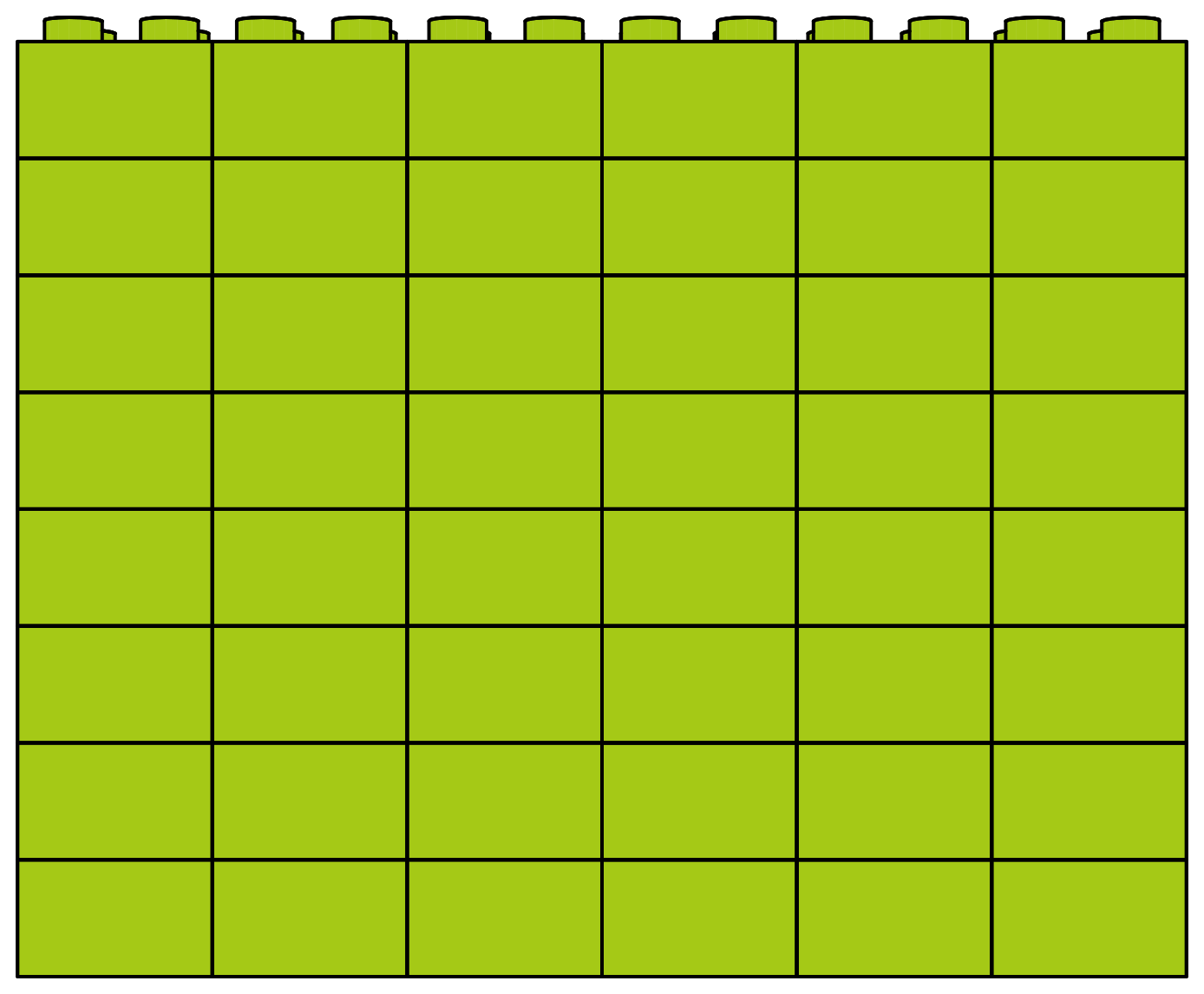
The area is equal to the total number of green bricks: \(6 \times 8 = 48\).
Count the bricks if you want to be convinced.
TipWhat is an area?
The area of a wall that is \(w\) LEGO bricks wide and \(h\) LEGO bricks high is equal to the number of bricks in the wall. We can compute it as follows:
\[ \text{area} = w \times h \]
Note that this is true for walls of any width, \(w\), and height, \(h\).
Similarly, volume is a measure of the size of a three-dimensional object. For example, the volume of the cube below is equal to the number of LEGO bricks that make up the cube.
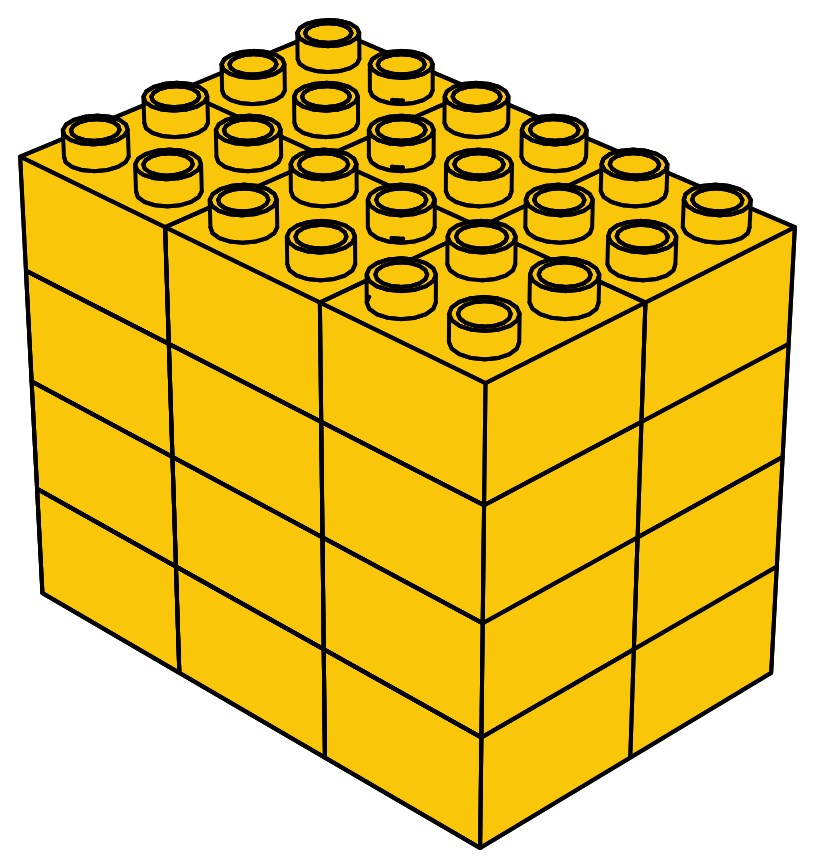
The volume is equal to the total number of yellow bricks: \(3 \times 4 \times 2 = 24\).
TipWhat is an volume?
The volume of a box with width \(w\), height \(h\), and depth \(d\) is the number of LEGO bricks that can fit inside the box. We can compute it as follows:
\[ \text{volume} = w \times h \times d \]
Keep in mind that this is true for any box with a width of \(w\), a height of \(h\), and a depth of \(d\).
6.1 Calculating rectangular areas 
Initially, we will focus on rectangular objects and then move on to other shapes. Examples of rectangular shapes include doors  , windows
  and flags.
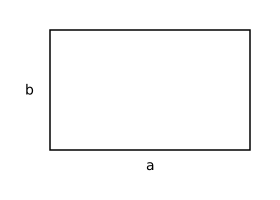
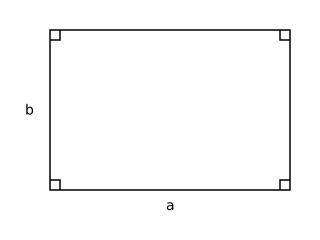
Given a general rectangle with width \(a\) and height \(b\):
The area of the rectangle is the space inside it.
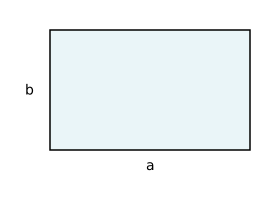
And is calculated as:
\[ \text{Area} = a \times b \]
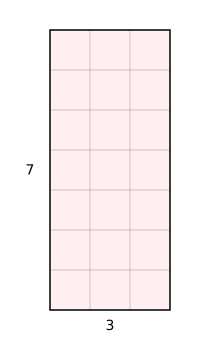
For example, the area of the rectangle below is \(21\), which is the number of unit squares inside it. Count them and see for yourself!
\[ \text{Area} = 3 \times 7 = 21 \]
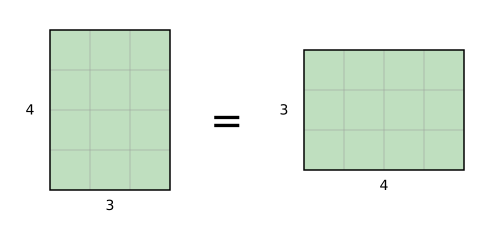
These rectangles have the same area, which is equal to:
\[ \text{Area} = 3 \times 4 = 4 \times 3 = 12 \]
Drawing areas on the Cartesian plane
We can also draw rectangles on the Cartesian plane.
In this case, the area is equal to the product of the horizontal and vertical distances between \((7, 4)\) and \((2, 0)\).
\[ \text{Area} = (7-2) \times (4-0) = 5 \times 4 = 20 \]
The area depends only on the distances, which are always positive, and not on the location of the rectangle. For example, the area of all the rectangles below is \(15\), regardless of their location, even if they are in the negative quadrants.
Squaring a number
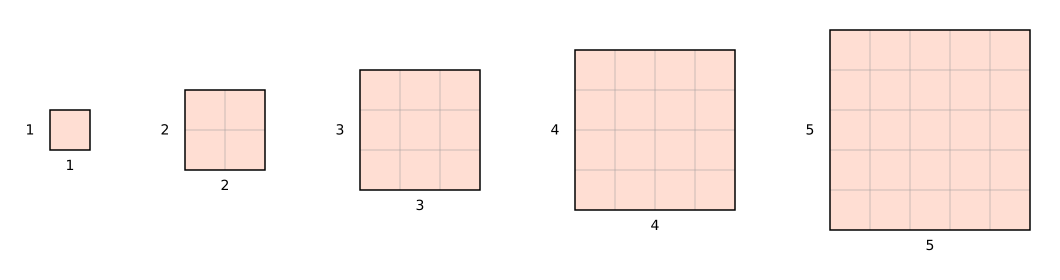
We learned that when we multiply a number by itself, we say that we are “squaring” it. These values appear diagonally in the multiplication tables.
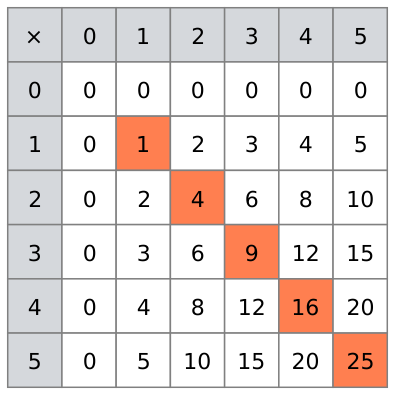
Now, we can see why it’s called “squaring.” The resulting rectangle is a square, with all sides of the same length. The rectangles below represent the same values as the highlighted elements on the diagonal of the multiplication table above. Count the number of unit squares and compare.
Exercises
Find the total area of the zoo. The total area is the sum of all the green spaces.
6.2 Triangles 
Triangles are the simplest type of polygon, with the fewest sides. They are so important in mathematics that an entire branch of the subject, trigonometry, is dedicated to studying them.
We can apply our knowledge of how to calculate the area of a rectangle to calculate the area of a triangle. Let’s see how.
The corners of a rectangle are right angles. This means that the two lines meeting at each corner are perpendicular to each other \(\perp\). Examples of right angles can be seen where two walls meet or where a wall meets the floor or ceiling. We can accentuate this with the following symbols:
If we split a rectangle in half, the resulting areas are each half of the area of the original rectangle, right?
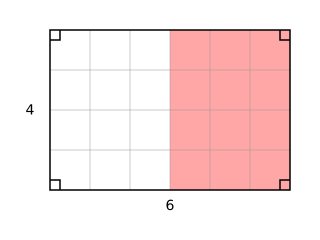
For example, the area of the rectangle below is \(6 \times 4 = 24\), and the area of the half red rectangle is \(\frac{6 \times 4}{2} = \frac{24}{2} = 12\). Count and convince yourself.
This is true no matter how we split the rectangle in half.
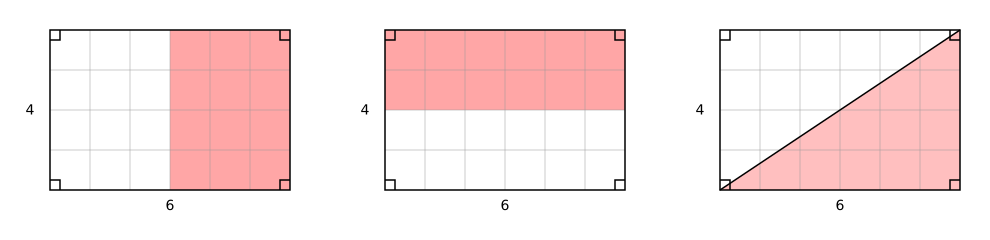
Because we can use it to calculate the area of a triangle. A triangle is half of a rectangle, so its area is half that of the rectangle.
The resulting triangles are called right triangles because they have a right angle.
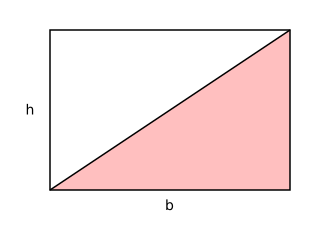
In general, for a right triangle with a base of \(b\) and a height of \(h\), the area is given by the formula:
\[ \text{Area} = \frac{b \times h}{2} \]
Exercises
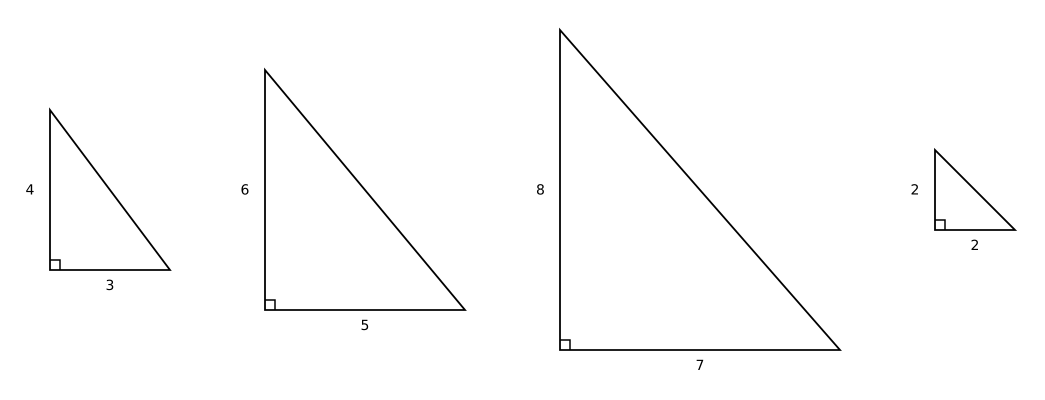
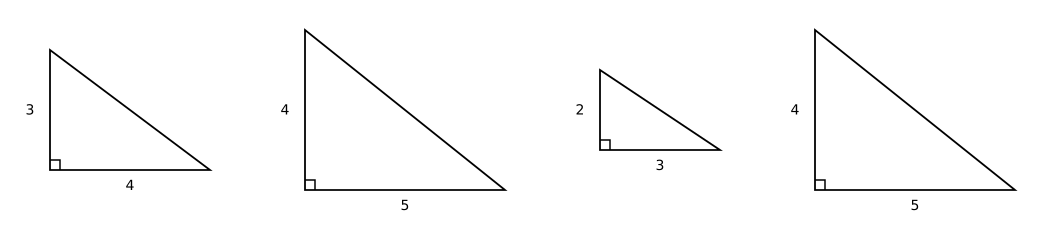
Calculate the area of the following triangles:
6.3 Proving the most famous theorem with paper  and scissors
Right triangles are important and useful. They have been studied since ancient times. One reason they are important is the relationship between the lengths of their sides. For example, you can use this relationship to calculate the shortest distance between two points on a plane.
I am going to show you the geometric relationship between the sides of a right triangle.
First, we start with a right triangle.
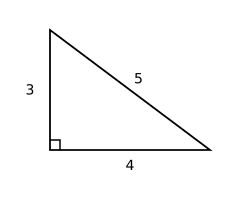
Now we are going to square the sides:
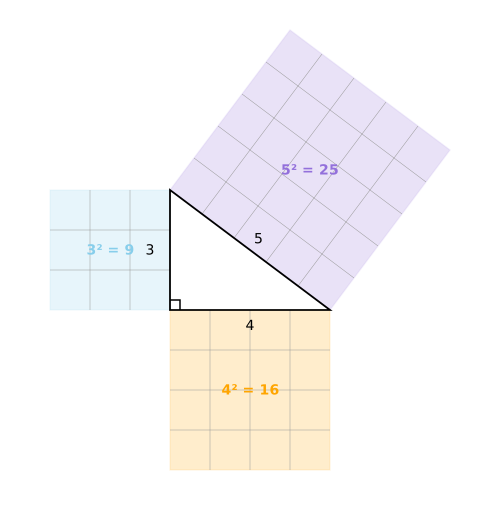
Observe the areas that they define:
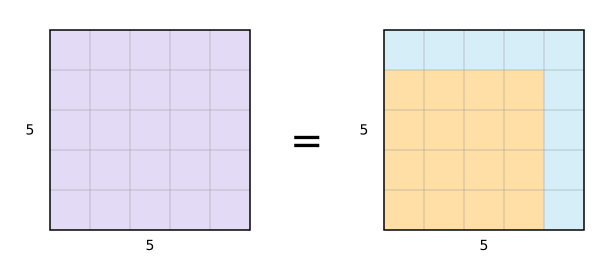
That’s right. For the triangle above, we have:
\[ 3^2 + 4^2 = 5^2 \]
Here is another example:
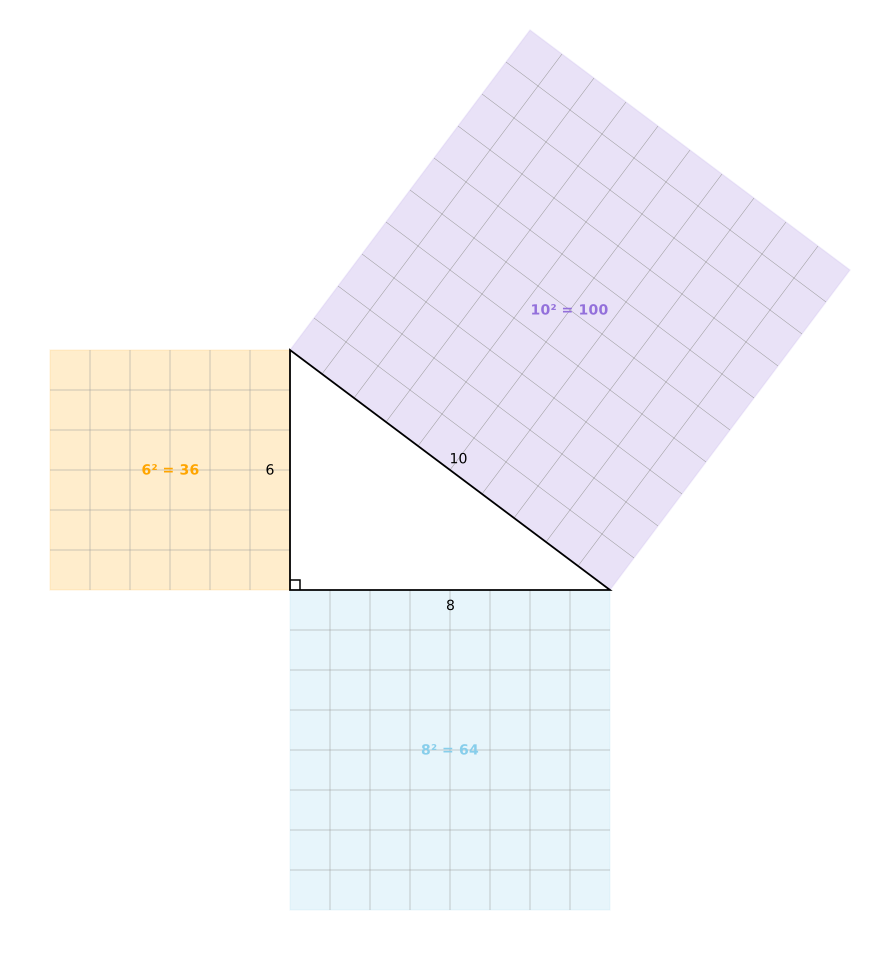
Does this hold true for any right triangle? It does; that result is called the Pythagorean Theorem.
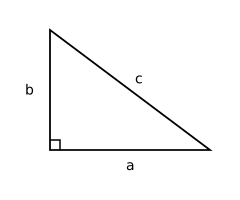
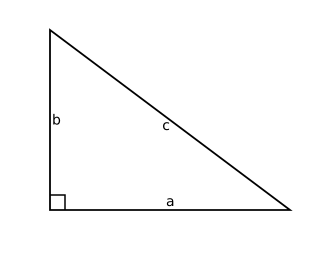
\[ a^2 + b^2 = c^2 \]
Caution What is a proof?
How can we be sure that this relationship holds for any right triangle? In mathematics, the only way to know for sure is to prove it. A proof is a logical argument that demonstrates the truth of a statement.
This will be our first proof.
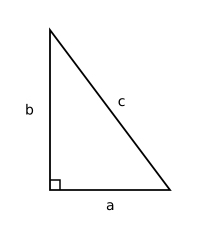
Let’s start with a right triangle whose sides have lengths \(a\), \(b\), and \(c\).
Now, we are going to arrange the four copies of the triangle inside a square with sides of length \(a+b\). We will color the triangles different colors, but keep in mind that they all have the same dimensions.
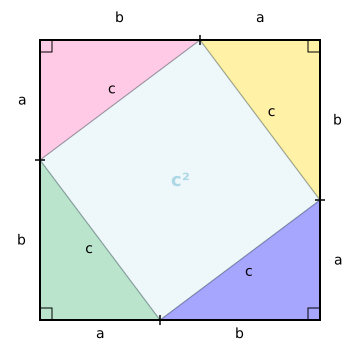
Note that rearranging the triangles in this way creates a square with side length \(c\) and area \(c^2\). This area is also equal to the area of the large square minus the area of the four triangles. Right?
Now, we are moving the triangles inside like this:
- The purple triangle remains where it is.
- We move the pink triangle so that its \(c\) side touches the \(c\) side of the purple triangle.
- Then, we move the green triangle to the top of the big square.
- Finally, we move the yellow triangle to the left of the big square.
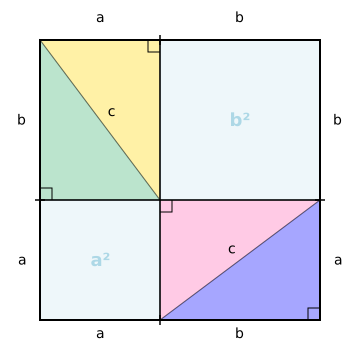
The light area has not changed; it is still the area of the large square minus the areas of the four triangles. By rearranging the triangles, we demonstrated that:
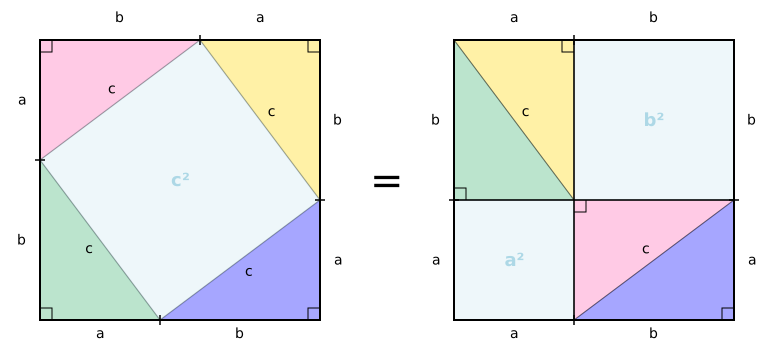
\[ c^2 = a^2 + b^2 \]
The Pythagorean theorem holds for any right triangle \(\blacksquare\). Congratulations! That’s your first proof!  .
.
We began this book by alluding to the proof of the most elusive theorem in the history of mathematics. That theorem is called Fermat’s Last Theorem, and it is closely related to the Pythagorean Theorem. The Pythagorean Theorem states that, for any right triangle:
\[ a^2 + b^2 = c^2 \]
However, Fermat’s theorem states that this relationship only holds true for squares and not for cubes or higher powers.
\[ a^n + b^n = c^n \quad \text{only for } n = 0, 1, 2 \]
But proving that one is a bit more difficult, so we are going to leave it for later! 
Exercises
We are going to do some crafts. Have paper or cardboard and scissors ready.
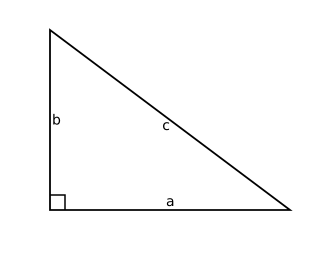
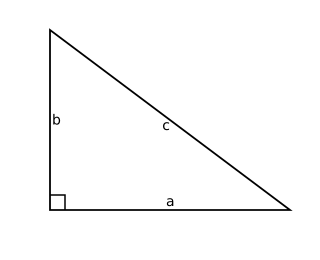
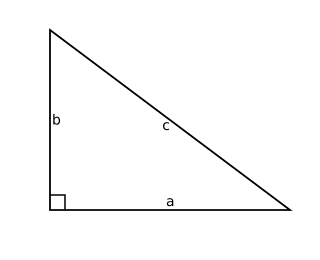
Draw or print four copies of the following triangle and color them in different colors.
Draw or print the following square:
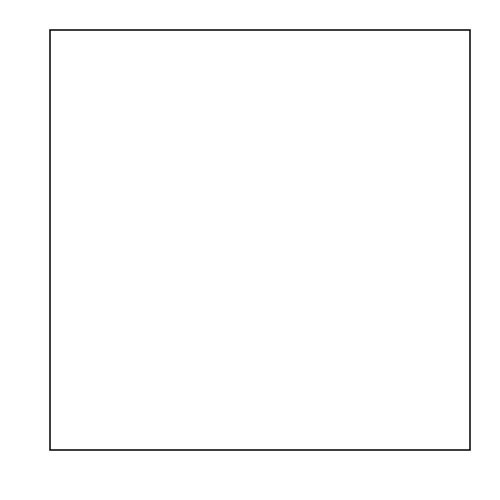
Use the colored triangles inside the square to illustrate the Pythagorean Theorem.
6.4 How much chocolate do you eat per year? 
I bet you love chocolate! You’re a chocolate monster!
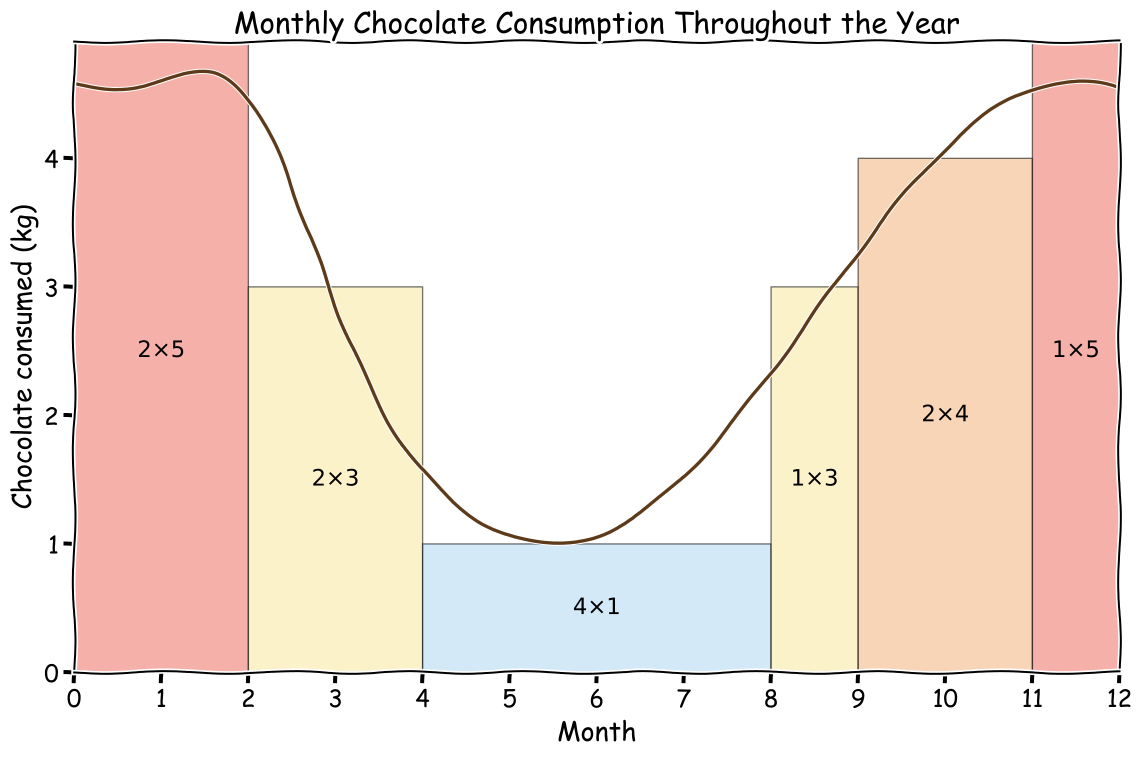
The following graph shows how much chocolate you eat each year. The x-axis represents the \(12\) months of the year. For each month, you can see how many kilograms of chocolate you eat. For example, in June (month \(6\)), you only eat about \(1\) kg. This is probably because you prefer gelato when it’s hot outside. On the other hand, you eat a lot of chocolate around Easter and Christmas—around \(4\) kg or more.
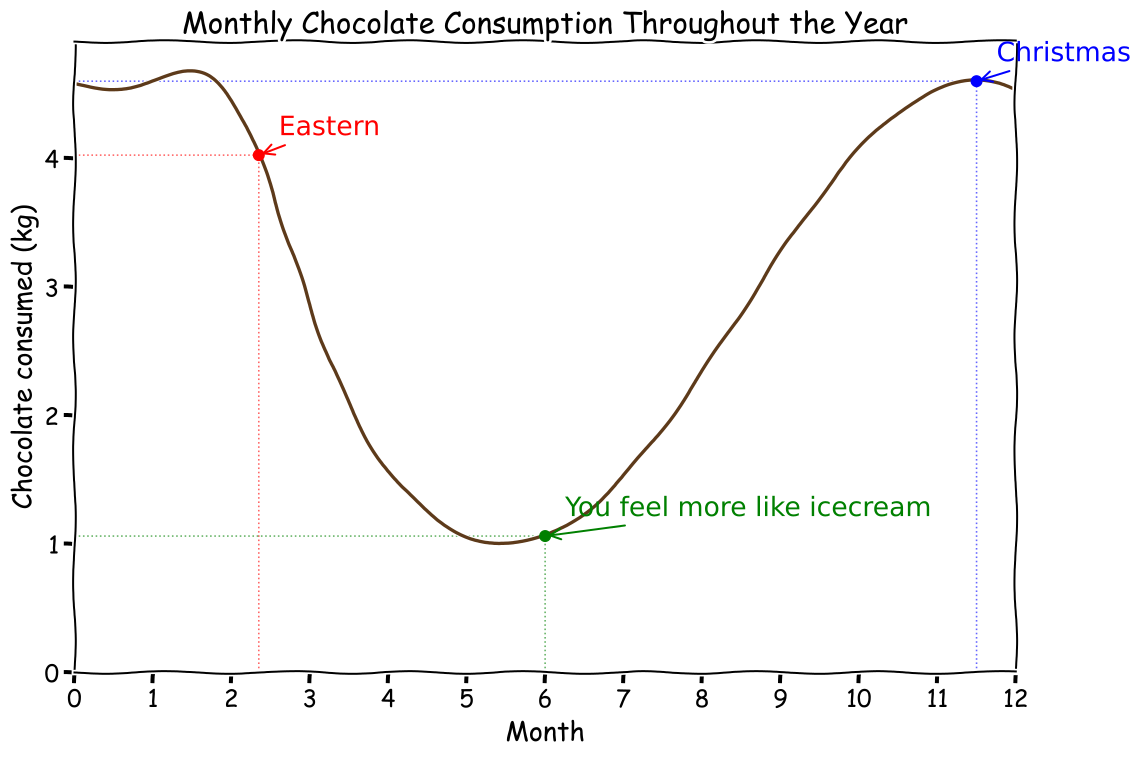
Caution How much chocolate do you eat per year?
In order to answer this question, you must calculate the total area under the above curve.

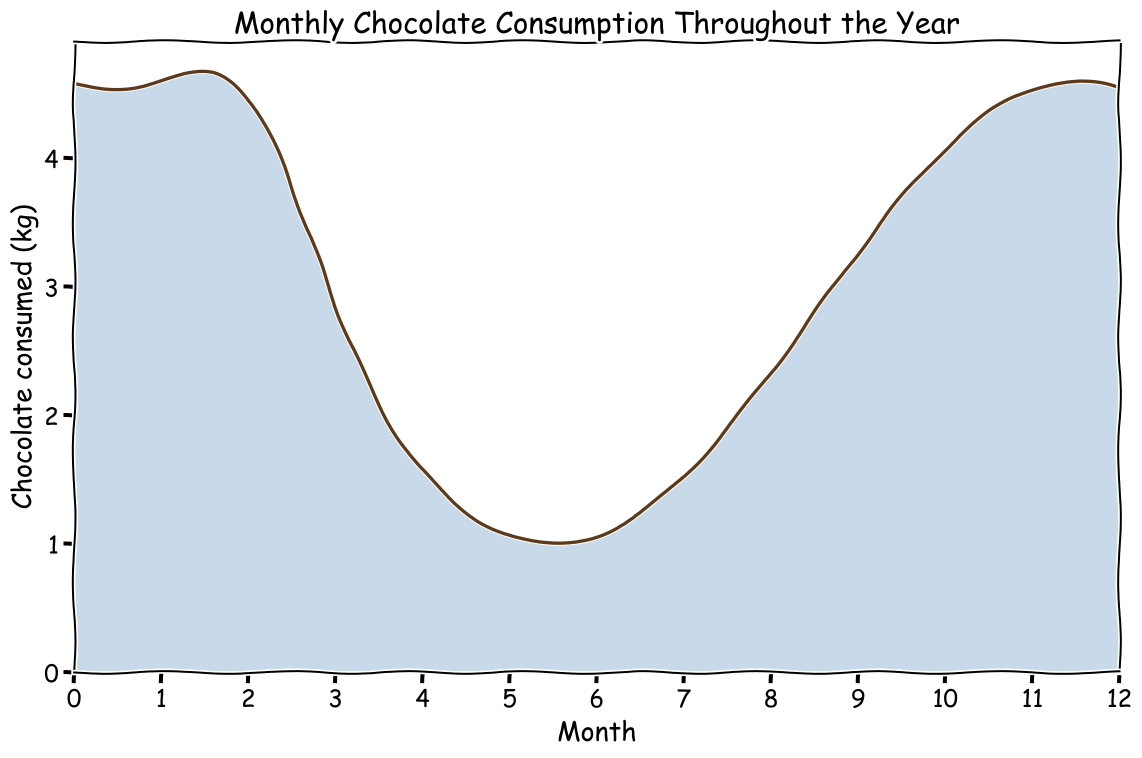
But wait a minute. We don’t know how to do that yet. We don’t know how to do it directly yet, but we can use our knowledge of how to calculate the area of rectangles to approximate it.
TipSpherical cows
Approximating means cutting corners and simplifying. For example, under some circumstances, if a quantity is \(9\), you can approximate it as \(10\) because \(10\) is easier to work with. Engineering and physics make heavy use of this technique. Sometimes it is useful to assume that things are points, that something is constant, and even that cows are spheres.

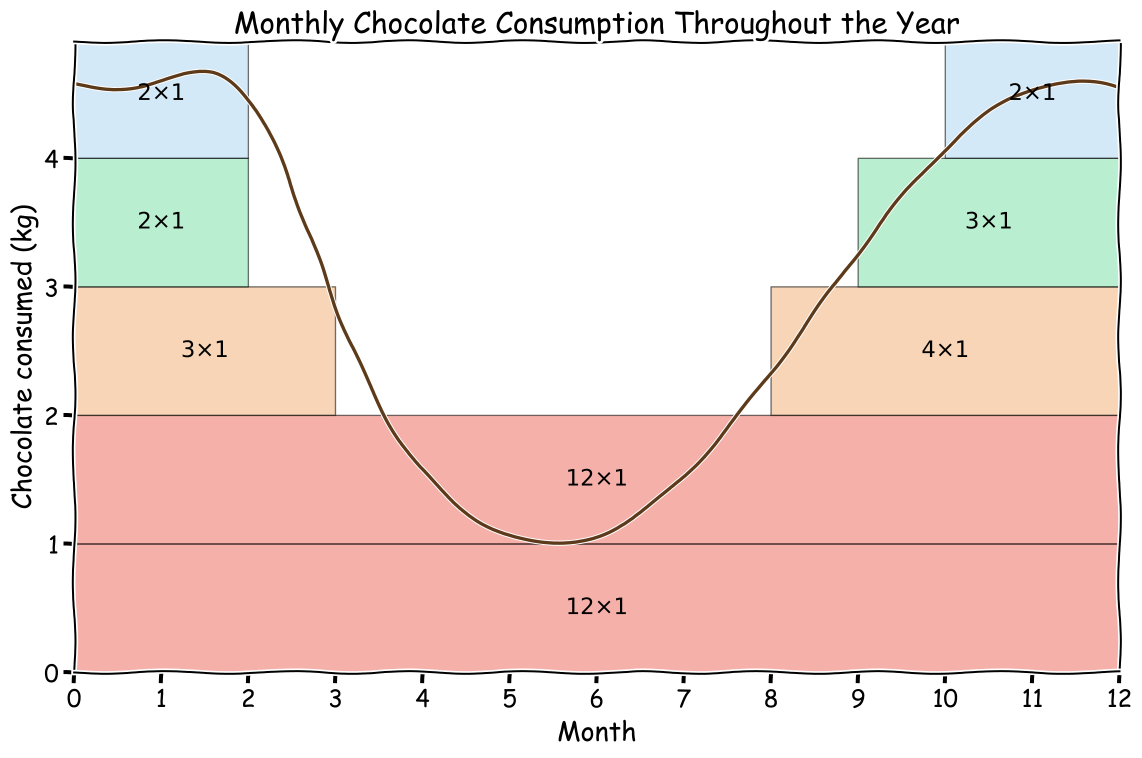
We can approximate the area under the chocolate consumption curve using rectangles. The total value would be the sum of the areas of the rectangles. This is not an exact value, but it will give you an estimate.
Compute your total annual chocolate consumption by adding up the areas of all the rectangles.
Exercises
- Based on the previous graph, compute the total amount of chocolate.
There is another way to calculate the area under the curve. Instead of using vertical rectangles, use horizontal rectangles. Compare the total area of the horizontal rectangles to the previous one. They should be similar, but not exactly the same.
Imagine going on a bike tour with your family. Your family loves cycling \(\text{\style{font-size:2em}{🚴♀️}} \text{\style{font-size:2em}{🚴♂️}} \text{\style{font-size:2em}{🚴♀️}}\) as much as you love chocolate.
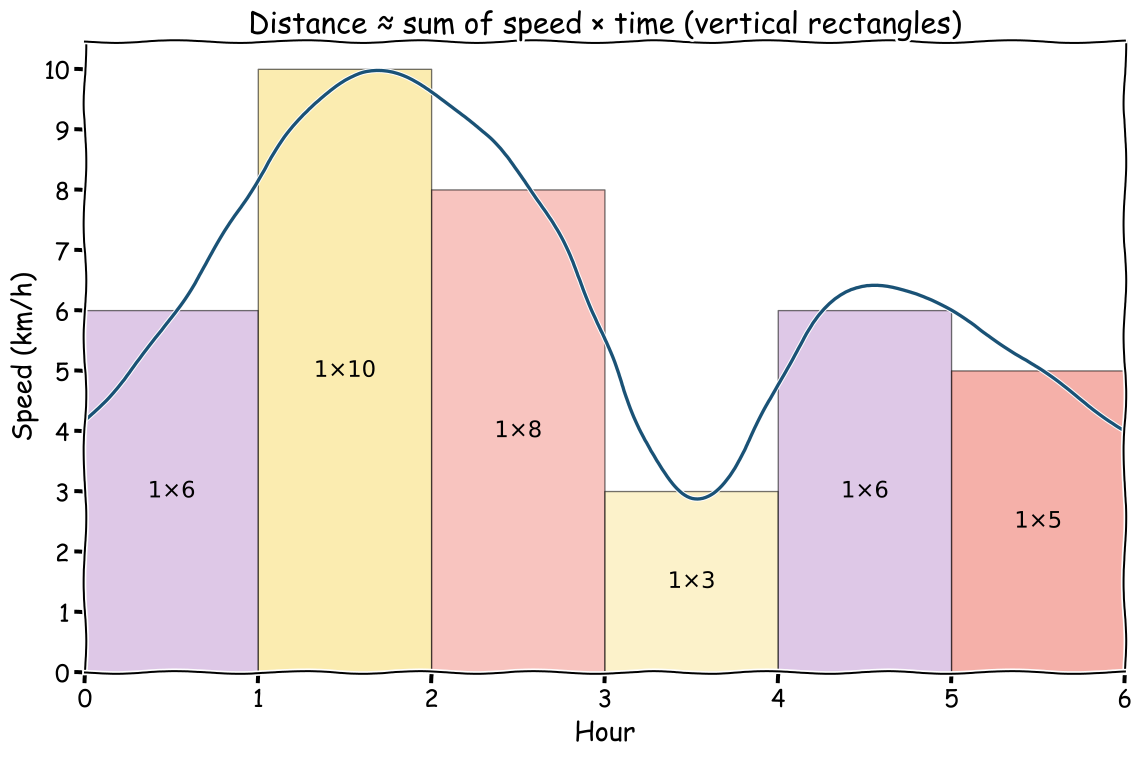
The following graph shows your speed during the tour.
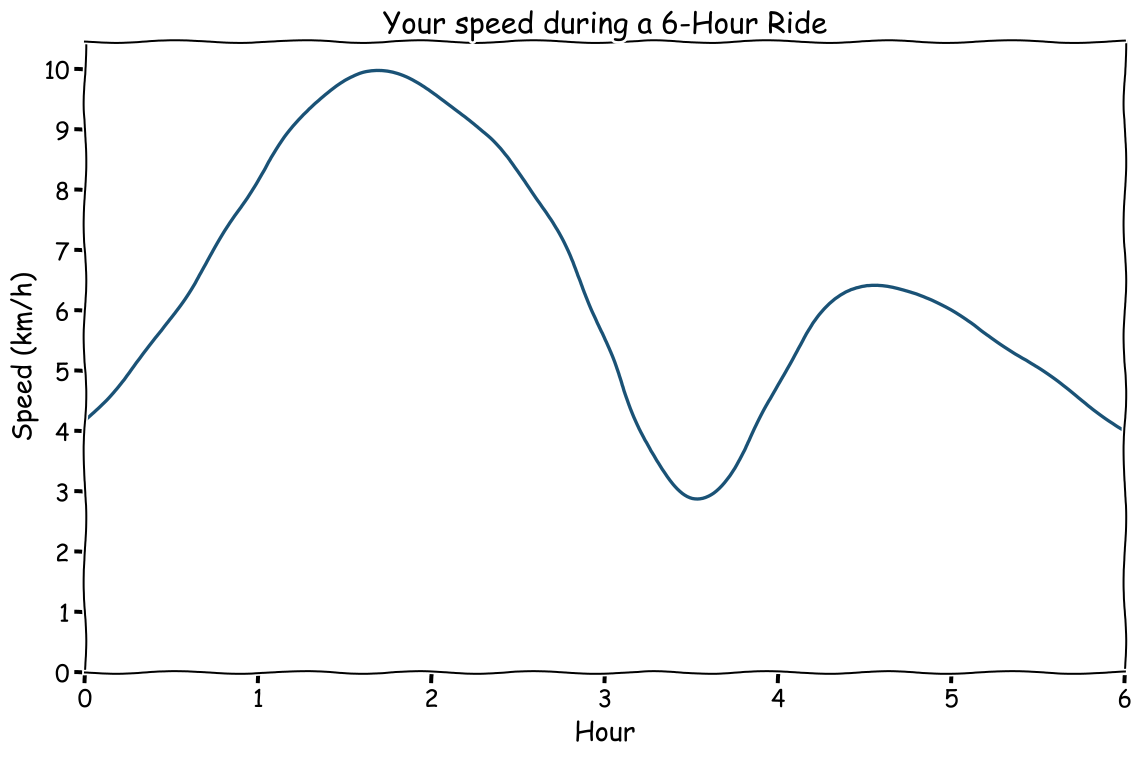
The area under the curve represents the total distance traveled. How far did you travel?