7 Pizza Math 
7.1 How much pizza do you eat?
I know for a fact that, besides being a chocolate  and a gelato
  monster, you also love pizza . Margherita, of course.
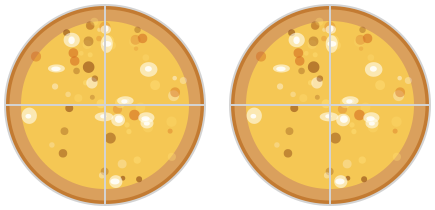
Some times you eat \(2\) pizzas in a single day.
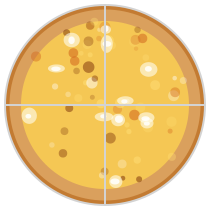
Other times, you eat just \(1\) pizza.
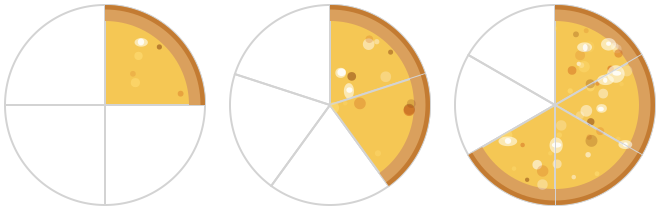
But some times you are not that hungry and you just eat a fraction of the pizza.
So far we have operated in the realm of the integers, which represent whole quantities. The very word integer means whole or complete.
In this chapter, we will learn about another set of numbers, called the rational numbers \(\color{purple}{\mathbb{Q}}\), which can be used to represent parts or fractions of whole quantities. We will learn that just as the natural numbers \({\color{red}{\mathbb{N}}}\) are included in the integers \({\color{blue}{\mathbb{Z}}}\), the integers are included in the rational numbers:
\[ {\color{red}{\mathbb{N}}} \subset {\color{blue}{\mathbb{Z}}} \subset {\color{purple}{\mathbb{Q}}} \]
7.2 How do you name these new numbers?
Naming fractions is easy. First, you need the number of parts into which the whole unit is divided. That number is called the denominator. Then, you need to know how many of those parts are included; that number is called the numerator.
=
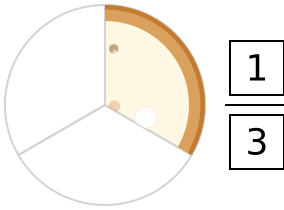
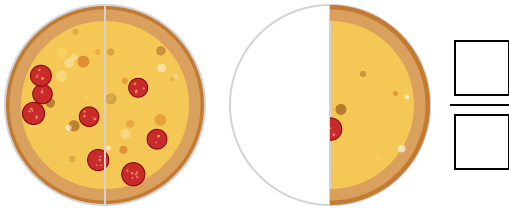
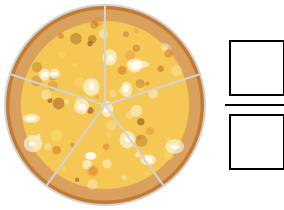
Now, let’s see how to represent these numbers. For example, the following quantity represents the fraction \(\frac{1}{3}\), which is read as “one third.” This means that the whole pizza is divided into \(3\) parts, and you eat \(1\) of those parts.
Exercises
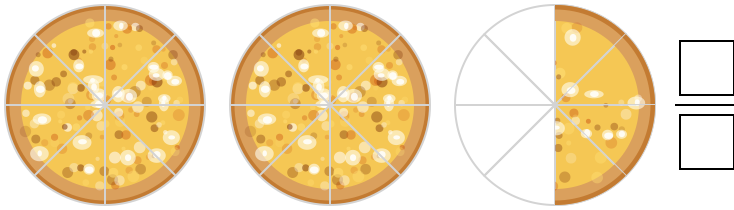
Write down the following fractions:
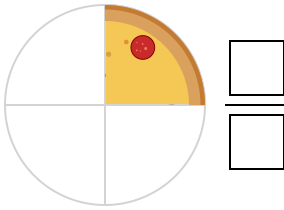
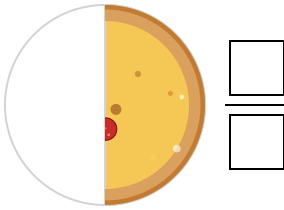
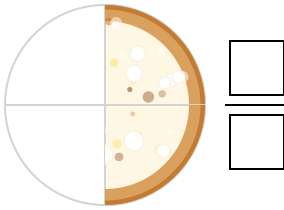
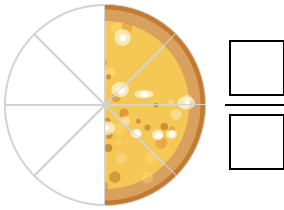
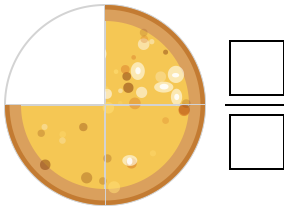
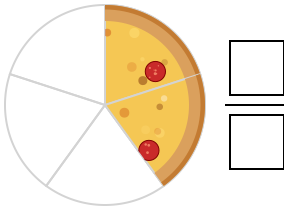
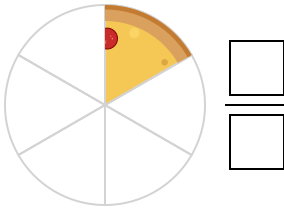
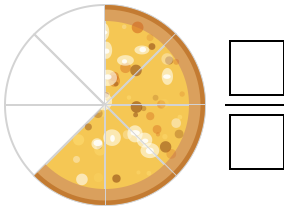
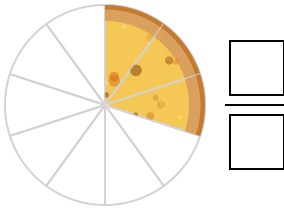
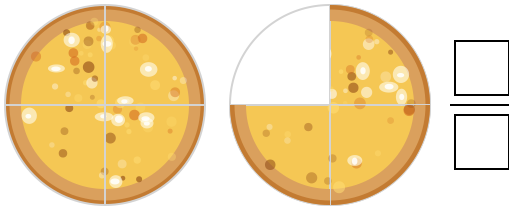
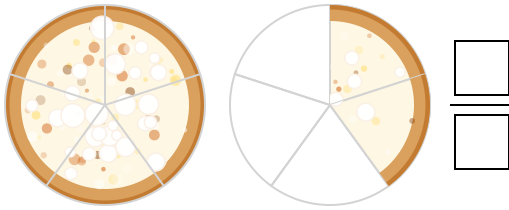
7.3 Comparing fractions
The reason the integers \(\color{blue}{\mathbb{Z}}\) are included in the rational numbers \(\color{purple}{\mathbb{Q}}\) is that the integers can be represented as fractions.
For example, no matter how many slices a pizza is divided into, if you eat all of them, you have eaten \(1\) whole pizza.
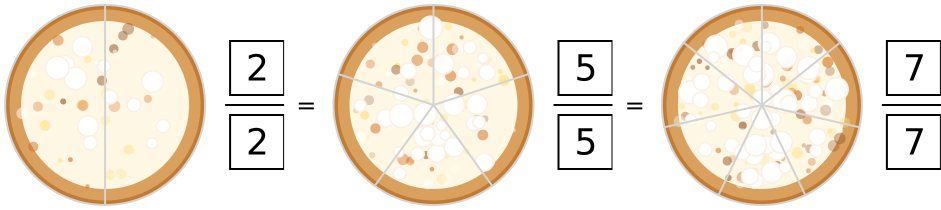
The same applies to any other integer. For example, \(2\) can be written as:
\[ 2 = \frac{2}{1} = \frac{4}{2} = \frac{6}{3} = \frac{8}{4} = \cdots \]
A fraction is equal to an integer whenever the denominator exactly divides the numerator. Here is another example:
\[ -3 = \frac{-3}{1} = \frac{-6}{2} = \frac{-9}{3} = \frac{-12}{4} = \cdots \]
Convince yourself that when the numerator and the denominator are equal, the fraction is equal to \(1\). If the absolute value of the numerator is greater than the absolute value of the denominator, the absolute value of fraction is greater than \(1\). Finally, if the absolute value of the numerator is less than the absolute value of the denominator, the absolute value of the fraction is less than \(1\).
TipAbsolute value
The absolute value of a number is the number’s value without sign. For example, the absolute value of \(-3\), represented as \(|-3|\), is \(3\), and the absolute value of \(3\), represented as \(|3|\), is also \(3\).
\[ \frac{a}{a} = 1 \quad \text{for any } a \neq 0 \] \[ |\frac{a}{b}| > 1 \quad \text{if } |a| > |b| \quad \text{and } b \neq 0 \]
\[ |\frac{a}{b}| < 1 \quad \text{if } |a| < |b| \quad \text{and } b \neq 0 \]
Exercises
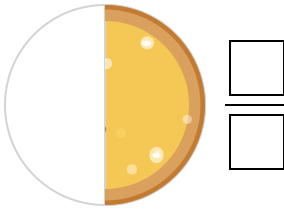
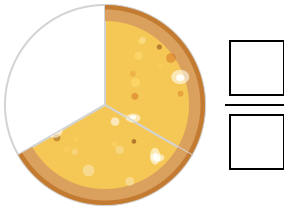
Write down the following fractions and determine whether they are equal to, greater than, or less than \(1\):
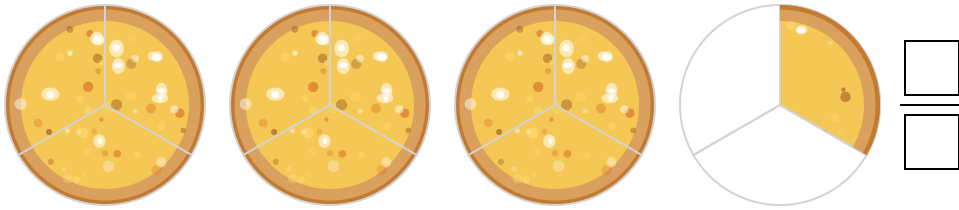
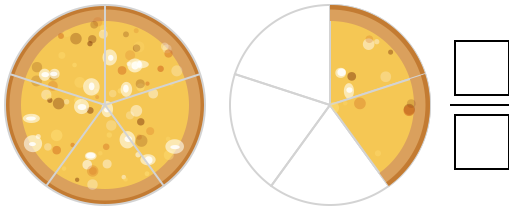
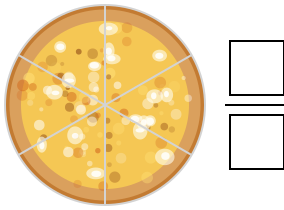
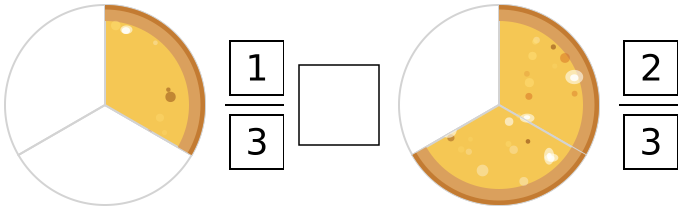
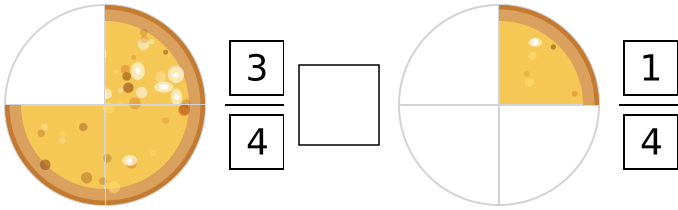
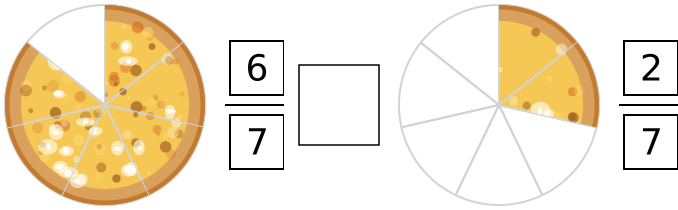
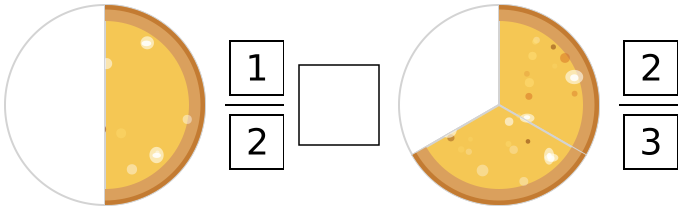
Compare the following quantities and write the appropriate symbol in the empty box: either \(<\), or \(>\), or \(=\).
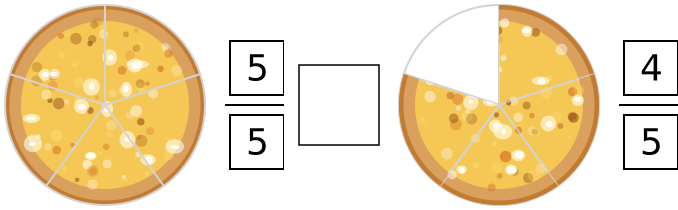
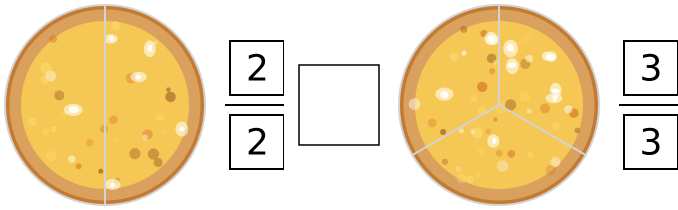
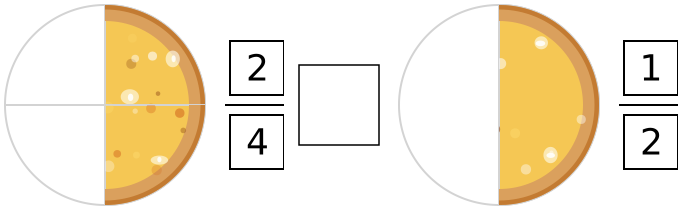
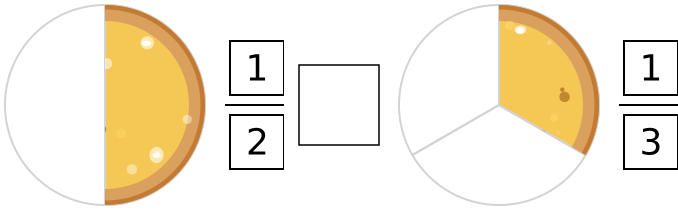
7.4 Fractions make you dance 
Fractions appear in many contexts, such as nature and art, where they describe proportions, symmetries, and ratios. In music, note durations are expressed as fractions relative to a whole note. What makes you dance when you listen to music is precisely the alternation of notes and rests of different durations. In other words, it is a succession of fractions that makes you dance.
The following symbols represent notes and rests (yes, silence is also very important in music) of different durations.
| Note | Value | American Name | British Name |
|---|---|---|---|
| 𝄜 | \(\color{red} 2\) | Double whole note | Breve |
| 𝅝 | \(\color{red} 1\) | Whole note | Semibreve |
| 𝅗𝅥 | \(\color{red}\frac{1}{2}\) | Half note | Minim |
| ♩ | \(\color{red}\frac{1}{4}\) | Quarter note | Crotchet |
| ♪ | \(\color{red}\frac{1}{8}\) | Eighth note | Quaver |
| 𝅘𝅥𝅯 | \(\color{red}\frac{1}{16}\) | Sixteenth note | Semiquaver |
| 𝅘𝅥𝅰 | \(\color{red}\frac{1}{32}\) | Thirty-second note | Demisemiquaver |
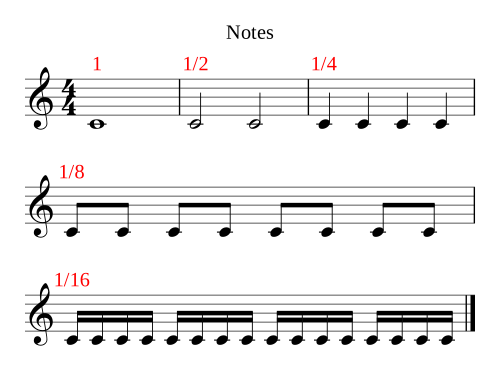
In the following score, each bar—each division of the staff—contains notes that sum to \(1\). \(1\) “whole” note worth \(1\), \(2\) half notes each worth \(\frac{1}{2}\), \(4\) quarter notes each worth \(\frac{1}{4}\), \(8\) eight notes each worth \(\frac{1}{8}\), and \(16\) sixteenth notes each worth \(\frac{1}{16}\).
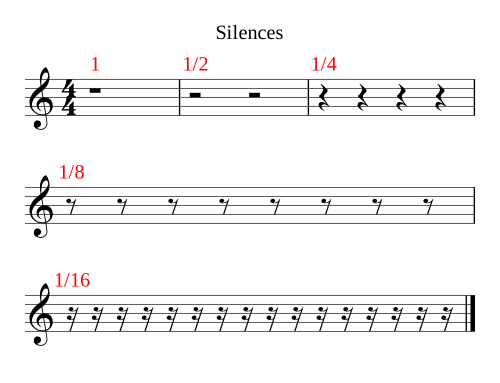
And similarly for the rests:
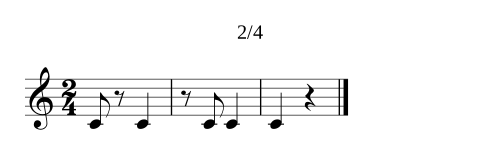
In the following score, the values in each bar sum up to \(\frac{2}{4}\), that is the same as \(\frac{1}{2}\).